

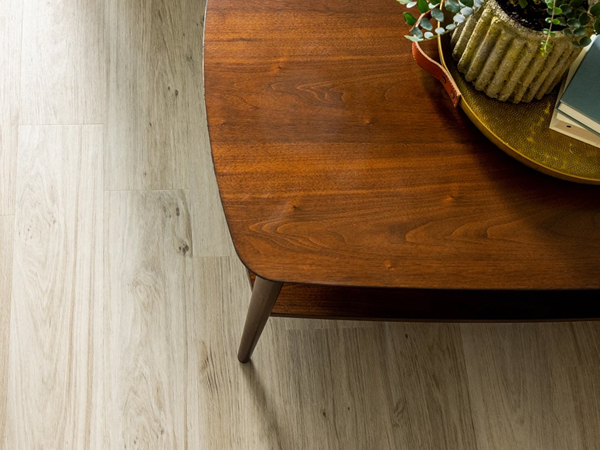
For most rooms in a Carolina Beach or Kure Beach home, luxury vinyl plank (LVP) is the better floor. Sheet vinyl is the better buy for small rooms where water can sit, like a laundry room or a kids' bathroom. Both are waterproof vinyl, so what really separates them is seams, the subfloor underneath, flood recovery and price.
Choose luxury vinyl plank for living areas, bedrooms, halls, stairs and open kitchens, and for any house you rent out. It looks more like wood, and a damaged board can be swapped on its own. It also tends to have a thicker wear layer, the clear top film that takes the traffic. Mohawk's SolidTech plank carries 12 to 22 mil (a mil is a thousandth of an inch), against 5 to 16 mil on Mohawk's VersaTech sheet vinyl.
Choose sheet vinyl for laundry rooms, water heater closets, small baths and tight budgets. A 12-foot roll covers most small rooms in one piece, with no seam at all. It is softer underfoot, and it costs less. The cost guide Fixr puts a 200-square-foot room at $800 to $1,200 installed in sheet vinyl and $800 to $2,400 in plank.
If the house floods, what the floor sits on matters most. Vinyl glued to a concrete slab keeps a small flood on top. On a plywood floor, FEMA's guidance is to pull the vinyl up so the wood can dry, and a floating plank floor comes up intact where glued sheet has to be cut out. Neither floor's warranty covers a flood.
In Carolina Beach and Kure Beach, the house matters as much as the room. A condo needs a floor that meets the building's sound rules. A house left empty needs its air conditioning left on, because both floors' warranties assume a climate-controlled home. And in an older cottage, test the old sheet vinyl for asbestos before anyone tears it up.
Side by side, plank wins on looks, toughness and repairs, and sheet vinyl wins on seams, softness and price.
| Factor | Sheet vinyl | Luxury vinyl plank |
|---|---|---|
| Seams | None in rooms under 12 feet wide | A joint at every board |
| Standing water | Fewer paths to the subfloor | Seal the edges in wet rooms |
| Flood over a wood subfloor | Cut out and replaced | Unclicked, dried, sometimes reused |
| Wear layer (Mohawk lines) | 5 to 16 mil | 12 to 22 mil |
| 200 sq ft room, installed | $800 to $1,200 | $800 to $2,400 |
| Repairs | Patch from a saved remnant | Swap the damaged boards |
| Underfoot | Softer and quieter | Firmer; a pad softens it |
| Best rooms | Laundry, small baths, utility | Living areas, kitchens, stairs, rentals |
The page starts with what each floor is and which one suits each room. After that come water and floods, the local house types (slab cottages, raised homes, condos and rentals), durability, looks, cost, installation and asbestos, warranties and repairs, care, choosing a product, and common questions.
What sheet vinyl and luxury vinyl plank are
Sheet vinyl and luxury vinyl plank (LVP) are both vinyl floors, but LVP is not a kind of sheet vinyl. Sheet vinyl comes off a roll as one flexible piece, usually 6 or 12 feet wide, says the Resilient Floor Covering Institute (RFCI), the trade group for these floors. LVP comes as separate boards that click together or glue down, much like a wood floor.
How sheet vinyl is made and installed
Sheet vinyl for homes is built in layers. RFCI describes a clear wear layer on top, a printed pattern under it, often a foam layer for comfort, and a felt or fiberglass backing. The backing decides how the floor goes down. Congoleum says felt-backed sheet usually needs glue across the whole floor, while fiberglass-backed sheet can be glued or loose laid with tape at the seams.
Armstrong's manual for its fiberglass sheets, such as CushionStep, adds rules that matter in a beach house. Loose lay is not approved in bathrooms, but a releasable glue is. Only Armstrong's permanent glue is approved for stairs, landings and rooms with a floor drain.
Width is sheet vinyl's biggest advantage. A 12-foot roll covers most bathrooms, laundry rooms and galley kitchens in one piece, so the only edges are at the walls, hidden under the trim. A wider room gets a seam. The installer cuts through both pieces at once for a tight fit and seals the joint with the maker's seam treatment.
How luxury vinyl plank is built
Luxury vinyl plank comes as separate boards in two main types. Flexible plank is glued to the subfloor. Rigid-core plank has a stiff core, a printed top layer and often a pad attached underneath, and it clicks together to float over the subfloor, in RFCI's definition. Because each board is separate, a damaged one can come out without disturbing the rest.
Rigid cores come in two kinds. This Old House describes stone plastic composite (SPC) as limestone mixed with PVC, which makes a denser board that resists dents. Wood plastic composite (WPC) uses wood fibers, plastics and foaming agents, which makes a softer, quieter floor.
The same maker's sheet and plank, side by side
The fairest comparison of sheet vinyl and plank is one maker's two products. Mohawk makes both, and its current warranty papers show plank ahead on wear layer and warranty length. They also put both products under the same two conditions: the home must stay climate controlled, and floods are not covered.
| Spec | Mohawk VersaTech sheet | Mohawk SolidTech plank |
|---|---|---|
| Thickness | About 1 to 3.6 mm | 4.5 to 7 mm |
| Wear layer | 5 to 16 mil | 12 to 22 mil |
| Residential warranty | 3 to 20 years | 25 years to lifetime |
| Needs a climate-controlled home | Yes | Yes |
| Covers flood damage | No | No |
A thicker wear layer generally means a floor that lasts longer, which is the main reason plank wins in busy rooms.
Sheet vinyl or LVP, room by room
Most beach houses here do best with both floors, sheet vinyl where water can stand and luxury vinyl plank (LVP) where people live. Here is how each room usually comes out and why, followed by how to join the two floors where one room turns into the next.
| Room | Better choice | Why |
|---|---|---|
| Full bath with a tub | Sheet vinyl, or plank sealed at the edges | Fewest paths for standing water |
| Powder room | Either | Little water; match the hall |
| Laundry or water heater closet | Sheet vinyl | One piece around leak-prone appliances |
| Kitchen open to living space | Plank | One floor through both rooms |
| Closed kitchen | Either | Sheet if the budget leads |
| Living room, bedrooms, halls | Plank | Wood look, thicker wear layer |
| Stairs | Plank with matching treads | Sheet on stairs is not advised |
| Mudroom or beach entry | Either | Mats matter as much as the floor |
| Ground level under a raised house | Ask the town first | FEMA flood rules apply |
| Screened porch | Neither | Warranties need climate control |
Bathrooms
In a full bathroom with a tub, sheet vinyl is the safer floor if water tends to sit. One glued piece, with its edges under the baseboard, gives splashes nowhere to go. Plank works in bathrooms too, if it is sealed with silicone at every edge and wherever it meets the tub or a door frame, the installation Mohawk requires before its WetProtect warranty will cover the subfloor.
Wet vinyl is slippery, which matters when people come in barefoot from the beach. Armstrong's care guide warns that vinyl, like other smooth floors, can be slippery when wet, so keep a non-staining bath mat by the tub. A powder room sees so little water that the choice is about looks, so match the hall.
Kitchens
In kitchens that open to the living room, run plank through both rooms and the house reads as one floor. In a closed kitchen, sheet vinyl is the budget choice, with one caution from Armstrong. Most damage to new sheet floors happens when appliances are moved, so walk the refrigerator and range across plywood panels rather than sliding them.
Cabinets are the other kitchen question. Armstrong allows base cabinets on its sheet only when the sheet is permanently glued. A floating plank floor should stop at the cabinets instead of running under them, because Mohawk's plank warranty excludes joints damaged by pinch points.
Laundry rooms, mudrooms and beach entries
The laundry room is sheet vinyl's best room. A washer hose or water heater can fail with nobody home, and one uncut sheet keeps the water on top. A mudroom or the door in from an outdoor shower sees sand and wet feet more than standing water. Either floor works there, and the mats matter as much as the floor.
Stairs
Stairs call for plank, which matters in raised houses and townhomes. Congoleum advises against installing sheet vinyl on stairs, and Armstrong approves its sheets on stairs only with permanent glue. COREtec makes vinyl stair treads with the nosing already attached, matched to its planks, so the stairs and the landing can be one floor.
Sunrooms and screened porches
Neither vinyl floor belongs on a screened porch or in any room that is not heated and cooled. Mohawk's plank warranty applies only indoors in dry, climate-controlled conditions, and Congoleum's sheet warranty excludes unheated rooms. A sunroom on the house's air conditioning suits either floor, with blinds drawn in strong sun. Plank there needs the wider 5/8-inch expansion gap Mohawk calls for where a room tops 85 F.
Where tile fits in
Tile is the third floor people weigh against sheet vinyl and plank, and it fares best on FEMA's flood list. FEMA rates ceramic and porcelain tile set in mortar as flood damage-resistant, while tile stuck down with organic adhesive is not. The trade-off is comfort and repairs. This Old House notes that tile can be cold and hard, and that luxury vinyl is warmer underfoot and easier to install and replace.
Using both floors in one house
Using sheet vinyl and plank in the same house works well if you plan where they meet. The two sit at different heights, since Mohawk's sheet runs about 1 to 3.6 millimeters thick and its plank 4.5 to 7, so each change of floor needs a transition strip. Put the change at a doorway, where the strip looks deliberate. We install the trim and transitions as part of the job.
Which is more waterproof, and what happens in a flood
Sheet vinyl and luxury vinyl plank (LVP) are both waterproof materials, so the question is where water can get past them. Sheet vinyl has fewer paths, because a small room has no seams, only edges at the walls. Plank has a joint at every board. And the makers' waterproof promises cover the flooring, not the plywood or concrete under it.
Spills, splashes and a leaking washer
For spills and wet feet, either floor is fine if you wipe the water up. The difference shows when water sits for hours, from a slow leak behind the washer, an overflowing toilet or a bath night with small children. Mohawk's SolidTech warranty spells out the limit. Its waterproof promise covers the plank against water on the surface, and it does not cover the subfloor.
Mohawk's answer for wet rooms is WetProtect, a system sold on some SolidTech lines. The installer seals the whole edge of the floor with matching trim or 100 percent silicone and fills the expansion gap with foam rod and silicone. Done that way, Mohawk extends the warranty to the subfloor for mopping and everyday spills that seep through the joints. Ask for that standard if you want plank in a full bath or a laundry room.
Sheet vinyl gets there more simply in a small room, with one piece, any seam sealed, and the edges under the baseboard. The installation still counts, which is why Armstrong approves its sheets in bathrooms only when they are glued down.
What floodwater does to glued and floating floors
What floodwater does to a vinyl floor depends on whether the floor is glued or floating, and on what it sits on. Glued vinyl on a concrete slab keeps a small flood on top, because, as This Old House notes, water cannot easily get trapped underneath. A floating floor on the same slab lets water run under the boards, where it sits until the floor comes up.
On a wood subfloor, the vinyl has to come up. FEMA's recovery advice after Hurricane Sandy is to remove all vinyl tile and linoleum over wood subfloors so the wood can dry, and its flood-materials bulletin applies the same reasoning to any vinyl over plywood. The EPA says water-damaged areas should be dried within 24 to 48 hours to prevent mold.
That is where plank earns its keep in a raised house. Glued sheet vinyl has to be cut out in pieces, while a floating plank floor can be unclicked, stacked and dried. Mohawk tells the story of a Houston model home flooded in Hurricane Harvey, where the SolidTech planks were taken up, dried and reinstalled. Treat that as the best case, since FEMA's homeowner guide says vinyl that has warped or come loose should come up.
The water does not have to come from the ocean. Hurricane Florence was a Category 1 storm when its eye crossed Wrightsville Beach in 2018, and the National Weather Service recorded more than 30 inches of rain at a few North Carolina sites over the next two days. Our guide to replacing floors after a Cape Fear flood covers the first 48 hours.
What FEMA counts as flood-resistant flooring
FEMA sets a hard test for flooring in flood zones. A material must survive at least 72 hours in floodwater and need nothing more than cleaning or cosmetic repair. By that test, FEMA's January 2025 bulletin accepts solid, single-layer vinyl sheet or tile only when it is set in chemical-set adhesive, such as epoxy. In ordinary adhesive it fails, and over plywood it fails too, because it must come up for the wood to dry.
The cushioned, layered sheet vinyl sold for homes is not that solid product, and click-together plank is not on FEMA's list at all. A local official can accept an unlisted floor only on test evidence.
This matters most on the ground level of a raised house. The base flood elevation is the height of the flood FEMA gives a 1 percent chance of happening in any year, the so-called 100-year flood. In FEMA's special flood hazard areas, everything below that line must be flood damage-resistant, including an enclosure under a raised home.
Before you finish that space, ask the town's planning staff what is allowed. Carolina Beach's flood-hazard page explains the VE and AE zones on FEMA's maps, and the town keeps elevation certificates on file.
Neither warranty covers a flood
Neither sheet vinyl nor luxury vinyl plank is warranted against a flood. Mohawk's current sheet and plank warranties exclude damage from leaks, storms and floods, and Congoleum's lifetime AirStep Advantage sheet warranty excludes water leaks and floods. A flooded floor is an insurance matter. So choose between the two on how you would recover, not on which one is marketed as more waterproof.
Which floor suits your kind of Carolina Beach or Kure Beach house
The right floor for a Carolina Beach or Kure Beach house depends on what kind of house it is. Census Bureau estimates for 2020 to 2024 show about half the homes in both towns empty at any given time, and about three in four of those held for seasonal or vacation use. Three in four Kure Beach homes are detached houses, while Carolina Beach has far more homes in multi-unit buildings.
A cottage on a concrete slab
Your cottage sits on a concrete slab, and the kitchen and bath still have old sheet vinyl. On a slab, a glued floor is the stronger choice wherever water is a risk, because glued sheet vinyl or glue-down plank keeps a small flood on top of the concrete. FEMA's list follows the same logic, since vinyl earns a flood-resistant rating only when it is glued to concrete with the right adhesive.
There is a trade-off. This Old House notes that a damaged click plank is relatively easy to replace, while a glued-down piece can be a headache. So on a slab, glue down the rooms where water is likely, like the kitchen, bath and laundry, and float plank in the dry rooms if you prefer. We install plank both ways.
Test the slab before either floor goes down. The makers set moisture limits, and sheet vinyl's are tighter. Congoleum allows 80 percent relative humidity in the slab under its felt-backed sheet, and Mohawk allows 90 percent under SolidTech plank. We do moisture testing and subfloor leveling before installation, and our article on subfloor moisture before laminate or vinyl explains what the test shows.
The old vinyl needs a test of its own. By Census estimates, about one in six Carolina Beach homes and one in five Kure Beach homes were built before 1970, and FEMA warns that many flooring products from that era contain asbestos. Have an accredited professional test the old floor before anyone scrapes it up.
A raised house on pilings
A raised house on pilings puts the floor on a wood frame, with open air or a storage level underneath. In FEMA's V zones, the coastal areas where storm surge brings waves, that is the rule rather than a choice, because the floor framing has to sit at or above the base flood elevation. Three things follow for the floor, and the first is the plywood, which has to be dry and stable.
Mohawk's plank guide caps a wood subfloor at 12 percent moisture. Armstrong warns that where humidity swings hard, a wood subfloor can move enough to push up a buckle in sheet vinyl near the walls.
The second is that sheet vinyl shows the plywood. Congoleum says sheet laid over a single layer of wood subfloor is more likely to show joints and nail heads, so it belongs over a smooth underlayment panel.
The third is the stairs. A raised house has at least one flight, and plank covers stairs with matching treads, while Congoleum advises against sheet vinyl on stairs. Add plank's ability to come up intact after a flood, and it is the better main-floor choice for most raised homes.
A condo with a neighbor underneath
In a condo with a unit underneath, the floor you choose affects your neighbor. That describes much of Carolina Beach, where about 44 percent of homes are in buildings with two or more units. North Carolina's building code requires the floor-ceiling assembly between units to reach an impact insulation class (IIC) of at least 50 in lab tests. Many associations add their own rules for hard floors, so get yours in writing first.
IIC rates the whole assembly, concrete or joists, ceiling and all, not the floor covering alone, so ask for a test report on a construction like your building's. Cushioned sheet vinyl helps, because its foam layer reduces impact noise, according to RFCI. With plank, the sound control comes from the underlayment or attached pad the maker specifies, and Mohawk says a SolidTech plank with a pad already attached cannot go over a second underlayment. Armstrong recommends a releasable glue for its sheets in condos and rentals, so the next remodel is easier.
A weekly rental or a house that sits empty
If you rent the house by the week or close it for the winter, keep the heat and air running. Mohawk warrants its sheet vinyl and its SolidTech plank only in homes that stay climate controlled. Congoleum's lifetime AirStep Advantage warranty excludes unheated rooms, and its felt-back sheet instructions say to keep the room between 55 and 100 F after installation, or the floor can bubble or buckle.
Guests are the other variable. They bring rubber-backed bath mats, and rubber can permanently stain vinyl, so Mohawk asks for mats with a non-rubber, non-staining back.
Some sheet vinyl is warranted against that very stain. Armstrong's sheet warranties of 10 years and longer cover it, and they apply to tenant-occupied homes as well as owner-occupied ones. Congoleum's AirStep Advantage covers it too.
Plank wins on turnaround. You can walk on Mohawk's SolidTech as soon as it is down, while Congoleum asks for light traffic for 24 hours after a glued sheet install and no washing for three days. Repairs between bookings favor plank too, since a gouged board is swapped from a spare box. Our article on Carolina Beach floors that survive vacation life covers the entry setup that keeps sand out.
One raised rental, both floors
Here is how both floors might come together in a raised Kure Beach rental. Plank runs through the living area, kitchen, bedrooms and halls and up the stairs with matching treads, while sheet vinyl goes in the laundry closet and the kids' bathroom. The main bathroom gets plank sealed with silicone at every edge, so it matches the bedroom. Walk-off mats go at every door, and the thermostat stays on all winter.
Sand and wet feet at the door
Sand is the beach house's wear test, and it wears both floors the same way, by scratching and dulling the wear layer. Mohawk's warranties for both products require walk-off mats at every outside door and recommend soft and firm fibers, plus a second set so the dirty ones can be cleaned weekly. Plank's thicker wear layer gives it more to lose before the pattern wears through, but mats and a regular sweep are what the warranties expect.
Which floor holds up better to sand, pets, furniture and sun
Luxury vinyl plank (LVP) holds up better in most homes, mainly because its wear layer is thicker and a damaged board can be replaced. Sheet vinyl's weak spots are tears when appliances are dragged and dents in its soft cushion. Plank's weak spots are its joints and heat.
Tears, gouges and dents
Sheet vinyl should not rip in normal use, and Mohawk warrants its VersaTech sheet against rips, tears and gouges from normal household use. Tears come from sliding heavy things, which is why Armstrong says most damage to new sheet floors happens during appliance moves. Dents are the cushion's weak point, so Congoleum asks for wide, flat furniture protectors and casters at least 2 inches across.
Plank dents less but can scratch or chip. Mohawk asks for protectors at least an inch across, soft rubber wheels on rolling chairs with a protective mat under them, and never dragging furniture. Armstrong does not recommend rolling casters on its sheet at all.
Pets
Both floors come in versions rated for pets, so read the pet terms before you buy. Armstrong's pet-friendly warranty covers dog and cat stains on its Duality and CushionStep Better sheets. Mohawk's SolidTech Essentials and Select lines carry its All Pet stain warranty, and SolidTech Plus and Premier carry All Pet Gold, which also covers pet scratches.
Other warranties leave pets out. Mohawk's VersaTech sheet excludes chewing, digging and clawing, and Congoleum's AirStep Advantage excludes damage from pet urine. Our article on pet-friendly vinyl floors that still look designer covers the colors that hide fur and scratches.
Sun and heat
Sun is where some sheet vinyl warranties beat plank. Armstrong's sheet warranties, except its one-year tier, say the floor will not fade or discolor from heat or sunlight. Mohawk's sheet and plank warranties and Congoleum's sheet warranty exclude sun and extreme heat, and Congoleum warns that a vent or appliance blowing air hotter than 120 F can scorch vinyl. Draw the blinds in strong sun, whichever floor you choose.
Rubber-backed mats and rugs
Rubber backings can permanently stain both floors, and every maker agrees on that. They differ on latex. Congoleum accepts 100 percent latex-backed mats labeled non-staining, Armstrong strongly recommends mats with no latex or rubber backing at all, and Mohawk asks for a non-rubberized back marked non-staining. The safe buy for either floor is a mat labeled non-staining with no rubber on the back.
Looks, comfort and sound
Luxury vinyl plank (LVP) looks more like wood, and sheet vinyl is softer and quieter underfoot. In a living room meant to read as hardwood, looks win. In a kitchen where you stand at the stove for an hour, or a condo over a neighbor, comfort and sound can matter more.
Is sheet vinyl outdated, and does it look cheap?
No, sheet vinyl is not outdated, but it looks like what it is, a printed floor without real joints. RFCI notes that sheet vinyl now comes in-register embossed, meaning the surface texture follows the printed grain. Stone, tile and patterned looks work well in sheet. A wood look is harder, because sheet cannot copy the edges of real boards.
So use sheet where a pattern suits the room, like a bathroom, laundry or retro kitchen, and plank where the floor should pass for hardwood. Our inspiration galleries show luxury vinyl in finished rooms.
Comfort underfoot
Cushioned sheet vinyl is the softer, warmer floor to stand on at a sink or stove. RFCI describes residential sheet as warm and quiet, with a foam layer for comfort. Plank is firmer. An attached pad or separate underlayment softens it, and This Old House notes that WPC plank is softer and quieter than SPC.
Noise
Sheet vinyl is the quieter floor, because it is glued down and its foam layer reduces impact noise, according to RFCI. A floating plank floor depends on what is under it. Mohawk says its underlayment for SolidTech reduces sound as well as helping level the subfloor, so the pad you choose with the plank decides much of how it sounds.
What sheet vinyl and LVP cost
Sheet vinyl is the cheaper floor. HomeAdvisor's cost guide, updated in June 2026 from what its customers report paying, puts sheet vinyl material at $1 to $2 a square foot and luxury vinyl plank (LVP) at $3 to $10. Installed, the cost guide Fixr estimates a 200-square-foot room at $800 to $1,200 in sheet vinyl and $800 to $2,400 in plank. Here is how that room adds up.
| 200 sq ft room | Sheet vinyl | Luxury vinyl plank |
|---|---|---|
| Material only (HomeAdvisor) | $200 to $400 | $600 to $2,000 |
| Installed (Fixr) | $800 to $1,200 | $800 to $2,400 |
| Removing the old floor (HomeAdvisor) | $200 to $400 | $200 to $400 |
| Subfloor repairs, if needed (HomeAdvisor) | From $400 | From $400 |
These are national figures, and some costs sit outside them. Sheet vinyl comes in 6- or 12-foot rolls, so an odd-shaped room can mean paying for more than it uses, as HomeAdvisor points out. Sheet also needs a smoother subfloor, which can mean more leveling. An older floor may need an asbestos test, and plank on stairs needs matching treads.
Over the life of the floor, repairs shift the math toward plank. A plank floor with a spare box is fixed board by board, while a sheet floor with no remnant may have to be replaced wall to wall. For bigger projects we offer financing, and our free estimates lay out material options, preparation and the installation timeline.
Installing either floor, and what to do about the old one
Sheet vinyl is the harder floor to install well, and luxury vinyl plank (LVP) is the easier one to put over an existing floor. Both need a flat, dry, sound subfloor, and both warranties depend on following the maker's instructions.
How flat the subfloor has to be
Sheet vinyl needs the flatter, smoother subfloor. Congoleum allows no more than 1/16 inch of dip or rise in a foot and 3/16 inch in 10 feet, because a nail head or plywood joint can telegraph through as a bump. Mohawk's plank guide uses the same 3/16 inch in 10 feet and warns that flaws can show through planks too. Either way, leveling is part of the job.
Can LVP go over old sheet vinyl or tile?
Yes, luxury vinyl plank can go over old sheet vinyl if the old floor is one layer, firmly stuck down and not cushioned. Mohawk's SolidTech guide allows plank over stable, firmly fixed hard floors but says to remove cushion vinyl first. COREtec says its planks can float over many existing floors, and This Old House notes that plank can go over old tile once the grout joints are filled and smoothed.
New sheet vinyl over old is stricter. Congoleum and Armstrong allow it only over a single, fully bonded layer that is not cushioned, with any texture filled flat. Congoleum rules out old flooring that contains asbestos.
Old sheet vinyl and asbestos
If your old sheet vinyl may date from before the 1970s, have it tested before anyone scrapes it up. The EPA lists the backing on vinyl sheet flooring, vinyl floor tiles and their adhesives among the places asbestos turns up, and FEMA's post-Sandy advisory warns that many pre-1970s flooring products contain it. The EPA recommends that a trained, accredited professional take the sample, not the homeowner.
If the test is positive and the floor is intact, the EPA's advice is to leave it alone and, when it needs replacing, cover it with the new floor if possible. A floating plank floor over a firmly bonded old sheet does that, where the plank maker allows it. If the old floor must come up, removal is a job for a licensed abatement contractor.
Pay attention to your nose, too. If there is visible mold or a strong musty smell where the old floor comes up, Congoleum says the source has to be found and fixed before new flooring goes down. That can mean replacing damaged underlayment or subfloor.
What installation day looks like
Installation day for either floor starts with an empty room. Congoleum's preparation list covers moving out the furniture and appliances, taking up the old flooring, removing the baseboards and trim you want to reuse, and repairing the subfloor until it is dry, clean and flat. Afterward, sheet vinyl needs a light-traffic day for the glue and seams, while a floating plank floor like Mohawk's SolidTech can be walked on right away.
Installing it yourself or hiring a pro
Plank is the floor homeowners install themselves, and COREtec calls its click system suitable for the average DIY installer. Sheet vinyl is harder, since a 12-foot roll is heavy and every cut is final. Congoleum, which writes its installation advice for do-it-yourselfers as well as pros, still highly recommends hiring a pro.
Whoever installs it has to follow the instructions. "Read the manufacturer's instructions carefully," says This Old House master carpenter Nathan Gilbert. "Some newer luxury vinyl products don't need to acclimate—though I still like to allow for it—and the size of the expansion gap can vary."
The warranty depends on it, too. Mohawk and Congoleum warrant their floors only when installed to their current instructions, and Congoleum covers labor for five years only on professionally installed floors. We install both sheet vinyl and luxury vinyl plank, floating or glue-down, with moisture testing, subfloor prep and a post-installation inspection included. Our page on professional flooring installation explains how it protects your warranty.
How long each lasts, what the warranty covers, and how repairs work
Luxury vinyl plank (LVP) usually outlasts sheet vinyl, because its wear layer is thicker. The makers' warranties are the best guide to how much longer, and they are worth reading past the headline number, since even a lifetime warranty shrinks with time.
Lifespan and warranties
Sheet vinyl warranties span the widest range. Armstrong's run from 1 year to lifetime, Mohawk's VersaTech from 3 to 20 years, and Congoleum warrants AirStep Advantage for as long as you own it. Plank starts higher. Mohawk's SolidTech lines carry 25 years to lifetime, and COREtec says most of its floors carry a limited lifetime warranty.
Lifetime rarely means full coverage for life. Mohawk prorates even its lifetime SolidTech warranty, paying in full for the first seven years and stepping down to 10 percent after year 20. For how wear layers translate into years in a real house, see our guide to how long luxury vinyl flooring lasts.
Sheet vinyl's seams have their own coverage when the floor goes in by the book. Congoleum warrants AirStep Advantage not to open at the seams for 20 years when installed to its instructions, and Armstrong guarantees its seams will not open for the warranty period when its installation system is followed.
Patching sheet vinyl vs replacing a plank
Repairs are where plank pulls furthest ahead. A damaged plank comes out and a new one goes in, and only that board is disturbed. Patching sheet vinyl takes more care, and This Old House shows the method.
- Cut a piece of matching remnant at least 4 inches wider and longer than the damage.
- Line up the pattern over the damaged spot and tape it in place.
- Cut through both layers at once, so the patch and the opening match.
- Glue the patch in, roll it flat and seal the edges with seam sealer.
- Keep traffic off it for 24 hours.
Both repairs need flooring from the original run. Mohawk's warranties exclude color and gloss differences in material added to a floor later, so keep the leftover planks or a good-sized piece of the sheet when the job is done.
Care that keeps either floor looking new
Sheet vinyl and luxury vinyl plank (LVP) take the same care, and at the beach most of it is about sand. Grit is what dulls and scratches the wear layer, so the first rule is to stop it at the door and get it off the floor. The makers' care guides agree on the rest.
- Sweep or vacuum often, with the beater bar off or on a bare-floor setting.
- Damp mop with a pH-neutral cleaner made for vinyl, and skip wax, polish, mop-and-shine products and detergents that leave a film.
- Do not steam clean. Congoleum and Mohawk say steam can damage their floors, and COREtec allows it only where a product is approved.
- Put non-staining mats with no rubber backing at every outside door, and wash them often.
- Use wide, flat protectors under furniture, and lift rather than drag anything heavy.
- Wipe up spills and wet footprints promptly, and draw the blinds in the strongest sun.
How to choose a sheet vinyl or LVP product
The best sheet vinyl or luxury vinyl plank (LVP) for your house is the one whose specs and warranty fit the room, and the brand matters less than those details. People ask who makes the best sheet vinyl. The better question is which line has the wear layer, backing and warranty terms your house needs, so check these points on any sample.
- The wear layer in mils, because it predicts how long the pattern survives sand and traffic.
- For sheet vinyl, the backing and the installation method the maker allows in your room.
- For plank, the core, whether a pad is attached, and whether the maker offers a subfloor warranty like WetProtect for wet rooms.
- The warranty's fine print on rips and tears, seams, rubber-backed mat stains, fading, climate control, labor and proration.
- The FloorScore seal for indoor air, and for a condo, an IIC test report for a construction like your building's.
Carpet Smart is a locally owned flooring store at 710 S 17th St in Wilmington, serving the Cape Fear region since 1999, including Carolina Beach and Kure Beach. We sell and install both floors. Our sheet vinyl comes from Armstrong, Congoleum, Mohawk and AHF Contract, and our luxury vinyl plank and tile from COREtec, Mohawk, Armstrong, Congoleum, Chesapeake and others. Samples ship free, and you can compare both floors side by side at our Wilmington showroom.
Questions people ask about sheet vinyl and LVP
Is sheet vinyl the same as linoleum?
No, sheet vinyl and linoleum are different floors, even though people call almost any resilient floor linoleum. RFCI describes linoleum as a natural product of linseed oil, wood flour, limestone, cork and tree resins on a jute backing, while sheet vinyl is layered plastic. On the coast the difference matters, because FEMA rates linoleum unacceptable in flood zones below the base flood elevation.
Is LVT better than sheet vinyl?
It depends on the room, and the answer matches plank's. Luxury vinyl tile (LVT) is the same product as luxury vinyl plank in tile shapes, according to RFCI. It gives a stone or ceramic look with separate, replaceable pieces and usually a thicker wear layer, at a higher price. Sheet vinyl stays the better pick for a small wet room you want in one piece.
Can you put sheet vinyl over LVP?
No, sheet vinyl should not go over luxury vinyl plank. When new sheet goes over an old resilient floor, Congoleum and Armstrong require that floor to be a single, fully adhered layer, and Congoleum rules out loose-laid floors, which a floating plank floor is. The plank has to come up first.
Does sheet vinyl need an underlayment?
It depends on the subfloor. Over wood, sheet vinyl usually needs a smooth underlayment panel, not a foam pad. Congoleum says rough or damaged subfloor panels must be sanded smooth or covered with a suitable underlayment, and Armstrong rules out particleboard and OSB under its sheets. On a clean, dry, flat slab, sheet vinyl goes straight down.
Which is better for indoor air, sheet vinyl or LVP?
Neither one is automatically better, so look for the FloorScore seal on whichever you choose. FloorScore means an independent certifier, SCS Global Services, has checked the product's volatile organic compound emissions against a California standard. RFCI's ASSURE program adds checks for heavy metals and ortho-phthalates on rigid-core plank. In an older beach house, the bigger risk to the air is disturbing old flooring that may contain asbestos.
Will LVP or sheet vinyl raise my home's value?
Not by much, so choose for how the house is used. This Old House notes that luxury vinyl often does not raise resale value the way hardwood, stone or ceramic tile can. What a vinyl floor does well is survive sand, pets, renters and spills, which is worth more in a beach house than a line on a listing.
What is better than luxury vinyl plank?
For most rooms in a beach house, few floors beat plank's mix of water resistance, looks and easy repair, but two rooms are exceptions. Where water can stand, sheet vinyl is better. Where you want real wood, only hardwood will do, with one caution: FEMA rates wood, engineered wood and laminate floors unacceptable below the base flood elevation.
If you are weighing both floors for a Carolina Beach or Kure Beach house, bring your room sizes and a few photos, and tell us whether the house is lived in full time, rented or closed part of the year. We will test the subfloor, check the old floor, and quote sheet vinyl and plank room by room. Request a free estimate to get started.


