

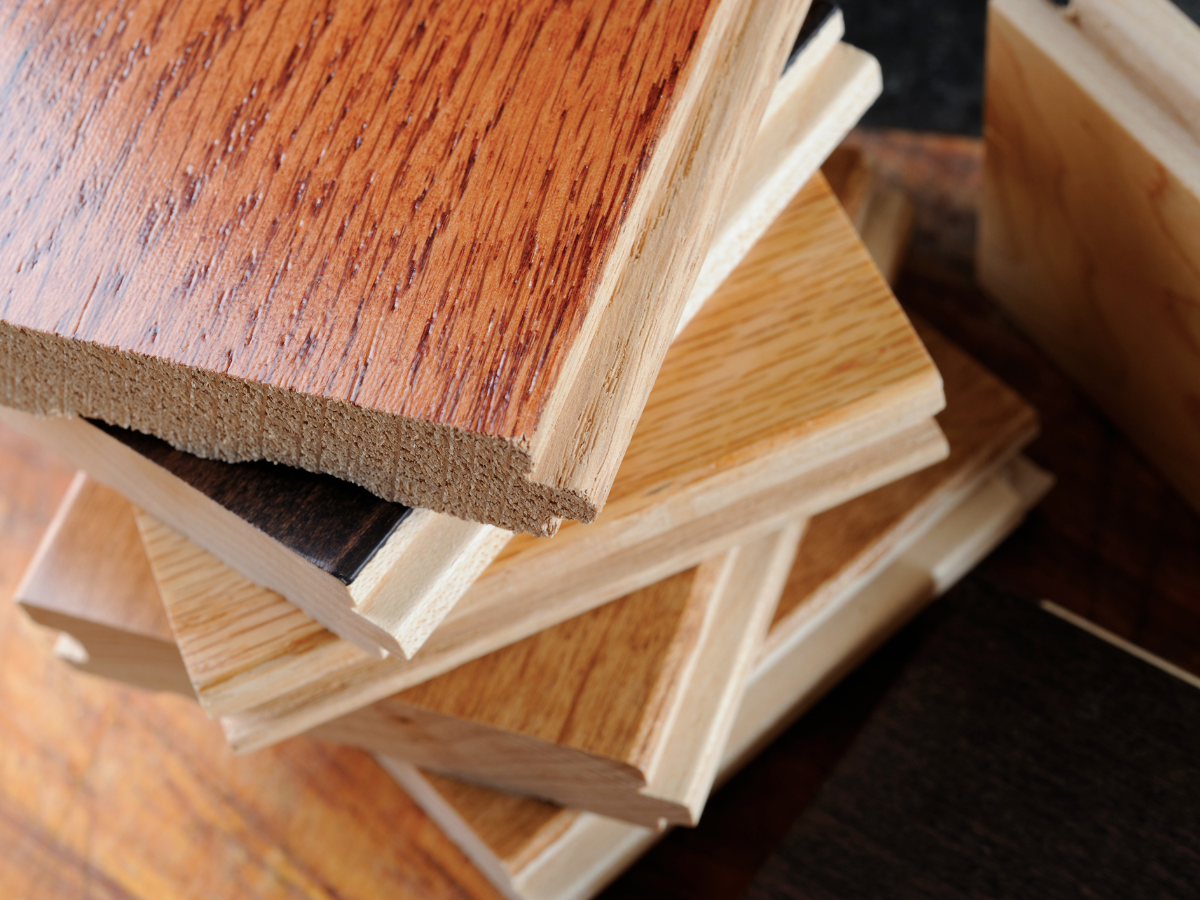
Both are 100% real wood where your feet and eyes meet them. Both take the same stains, the same textures, the same species. The difference is everything underneath — and on the Cape Fear coast, where summer air regularly holds 70 to 90 percent humidity, that difference decides whether your wood floor stays flat for decades or fights you every August.
We install both across the region, so you're getting the comparison we give across the showroom counter, including the parts each product's marketing leaves out.
What's Under the Surface of Each Plank
Solid hardwood is one piece of lumber, top to bottom — usually 3/4 inch thick. What you see on top runs all the way through, which is why solid floors can be sanded back to new again and again.
Engineered hardwood puts a genuine hardwood wear layer — anywhere from 2 to 6 mm on quality products — over a core of five to nine thin wood plies, each glued with its grain running crosswise to its neighbors.
That cross-grain core is the entire argument. Wood swells and shrinks with moisture, and it moves mostly across the grain. In a solid plank, every board in your floor is pushing sideways against its neighbors as humidity rises. In an engineered plank, the layers pull against each other and cancel most of that movement before it reaches the surface. Once installed, the two are visually identical — you can compare them plank for plank in our hardwood collection, and our hardwood information guide covers the material's benefits in general.
Humidity Casts the Deciding Vote on Our Coast
Wood floors are happiest when indoor humidity stays between roughly 35 and 55 percent year-round. Inland homes with steady HVAC can hold that range. The closer you get to the water, the harder it gets — porch doors stay open, salt air stays damp, and beach houses often sit with the air conditioning off between visits.
Here's how that plays out by address:
Beach and island homes: In Wrightsville Beach, Carolina Beach, Kure Beach, and Topsail Beach, engineered hardwood is the safer real-wood choice by a wide margin. Vacation homes that sit unconditioned between stays put solid wood through humidity swings it was never designed to absorb.
Slab-foundation homes: Much of Leland and Hampstead sits on concrete slabs. Solid hardwood generally can't be nailed to concrete; engineered glues or floats over a slab beautifully — after a moisture test, which is where slab installs live or die. Our guide to subfloor moisture before installation explains what those tests catch.
Established Wilmington neighborhoods: Crawlspace foundations, steady climate control, and wood subfloors are solid hardwood's natural habitat. Plenty of century-old solid floors downtown prove the point.
The Case for Solid: A Floor You Can Renew for Generations
Solid hardwood's advantage compounds over decades. With about a quarter inch of wood above the tongue, a solid floor can take four to six full sandings across its life. You can change its stain color in 2040 and again in 2060. Our own sand & finish team regularly revives solid floors older than the houses around them.
Solid also gives you the full species menu at maximum thickness. A few numbers worth knowing from the Janka hardness scale, which measures how well a wood resists denting:
Red oak — 1,290: The American benchmark. Sands well, takes stain evenly, always in style.
White oak — 1,360: Slightly harder, with closed grain that sheds moisture better than red oak. Our first recommendation for coastal solid installs.
Hickory — 1,820: The dent-fighter for big dogs and busy households, with bold grain character.
Heart pine — around 870: Softer, but full of history — it dents into character rather than damage, which is why older local homes wear it so well.
If you're in a forever home on a wood subfloor with reliable air conditioning, solid is hard to argue against.
The Case for Engineered: Stability Where the Climate Fights Back
Engineered hardwood earns its place through what it doesn't do: it doesn't gap in January, cup in August, or panic over a slab foundation. A few specifics that matter when you're shopping:
Wear layer thickness is the spec to check. A 2 mm layer allows one careful refinish down the road; 3 mm or more may allow two. Under 2 mm, treat the floor as finish-it-once. The number is on the spec sheet, and we'll show you where.
Wide planks are engineered's home turf. The wider a solid board, the more visible its seasonal movement — past 5 inches, solid gets risky in our humidity. The 7-inch-plus planks driving today's coastal looks are built on engineered cores for exactly this reason.
More installation options. Nail-down over wood subfloors, glue-down over tested slabs, and floating systems — flexibility solid can't offer.
The honest trade-off: engineered has a refinishing ceiling, and bargain products with paper-thin veneers give the category a bad name. Buy the wear layer, and engineered will outlast the mortgage.
Where Each One Wins, Room by Room
Most of the wood projects we install use this logic:
Main living areas: Either — let your foundation and HVAC habits decide.
Whole main levels on slab: Engineered, full stop.
Bedrooms and upstairs: Either; engineered floats quietly over existing subfloors with the right underlayment.
Kitchens: Engineered if you insist on wood there; its stability handles the humidity swings of cooking better. Many coastal kitchens skip wood entirely for a waterproof surface, and we'll tell you when that's the wiser move.
Full baths and laundry rooms: Neither. Real wood and standing water don't negotiate. Our comparison of laminate vs. hardwood in Hampstead and Leland humidity covers the wood-look alternatives for those rooms.
Factory Finish or Site Finish: A Choice Hiding Inside the First One
Whichever construction you pick, you'll also choose how your floor gets its finish, and the difference shows up for the next twenty years.
Factory-finished (prefinished) planks arrive with their coats already cured under UV light, usually with aluminum oxide baked into the topcoat. Those finishes are dramatically more abrasion-resistant than anything applied in a living room, the warranty on the finish comes from the manufacturer, and you walk on the floor the same day it goes in. The trade-off sits at the edges: prefinished planks have tiny bevels between boards, and the floor can only be dead-flat sanded once those bevels are ground away in a future refinish.
Site-finished floors get sanded and coated in your home after installation. You gain a perfectly smooth, monolithic surface, seamless custom stain matching, and edges sealed as one piece — the traditional look in Wilmington's older homes. You give up a few days of cure time and accept a finish that, while excellent, wears faster than factory aluminum oxide.
Busy family homes usually lean prefinished for the tougher topcoat. Historic renovations and custom color matches lean site-finished. Both live in our showroom, so you can run a key across a sample of each and see the difference yourself.
What Real Wood Costs, Honestly
Species, plank width, and wear-layer thickness drive material price more than the solid-versus-engineered question does — a premium engineered white oak can cost more per square foot than builder-grade solid red oak. Installed cost often narrows further, because engineered installs faster and skips the sanding-and-finishing days that site-finished solid requires.
Budget honestly for the quiet line items: subfloor prep, moisture mitigation on slabs, old floor removal, and transitions. Those appear itemized on your quote from us rather than surfacing as surprises mid-project, and financing is available when the right floor and the right month don't line up.
Installation Is Where Wood Projects Succeed or Fail
Wood is the least forgiving floor to install, and the failures we get called to fix almost always trace to skipped fundamentals rather than bad product.
Before a single plank goes down, the wood needs to acclimate in your home — sitting on site until its moisture content lands within a few percentage points of the subfloor's, which NWFA guidelines require and impatient schedules skip. Slabs get moisture-tested with calcium chloride or in-slab probes, wood subfloors get checked with a meter, and expansion gaps stay hidden under baseboards to give the floor room to breathe seasonally.
All of that comes standard with our professional installation, done by our own crews rather than subcontractors. It's the reason the manufacturer warranty on your floor actually holds up.
Stand on Both Before You Decide
Specs narrow the choice; your feet finish it. Visit our showroom at 710 S 17th Street and compare solid and engineered planks in the same species and stain, side by side. Or start at home — schedule a free in-home estimate or call (910) 362-9700, and we'll check your subfloor, measure your rooms, and give you a straight recommendation for your exact address. Hampstead new build, Wrightsville Beach cottage, or a downtown four-square with stories to keep — the right wood exists for each, and we've been matching them since 1999.


