

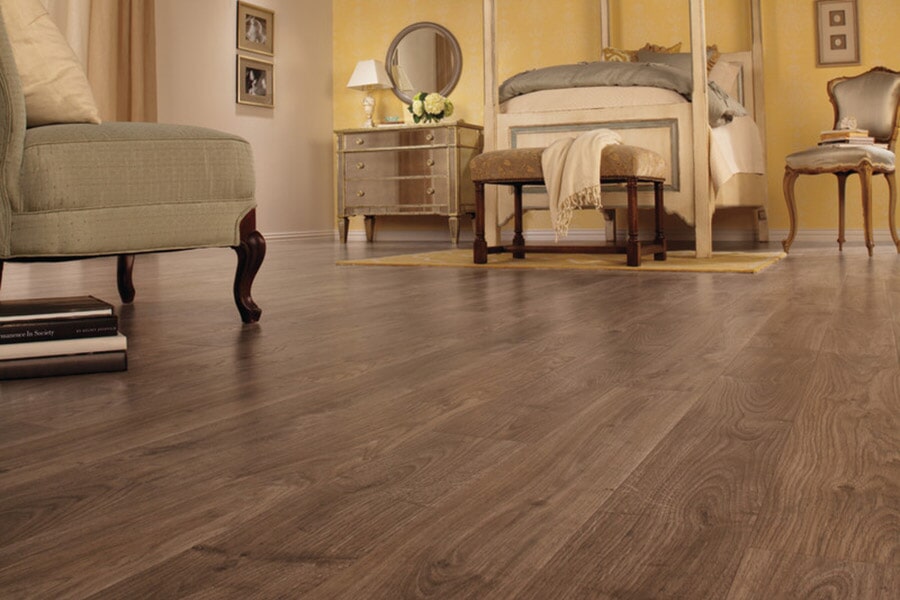
A quality laminate floor should give you 15 to 25 years — and in bedrooms and quieter rooms, often longer. A cheap one installed carelessly can start swelling at the edges before its third summer. Both outcomes happen in homes around Wilmington every year, and the difference comes down to four decisions you make before the first plank ever clicks together.
We've installed laminate across the Cape Fear region since 1999, and we've also torn out plenty of it that failed early. Here's what separates the floors that go the distance from the ones that don't.
What Laminate Is Made Of, and Why It Ages the Way It Does
A laminate plank is four layers pressed into one: a clear wear layer of melamine resin infused with aluminum oxide on top, a printed design layer beneath it, a high-density fiberboard (HDF) core that gives the plank its body, and a backing layer that balances the whole sandwich.
Two of those layers control lifespan. The wear layer decides how the floor handles feet, claws, and sand. The core decides how it handles moisture. Every early laminate failure we've pulled out of a local home traces back to one of those two — a wear layer that was too thin for the traffic, or a core that met water it couldn't handle.
Here's a fact that surprises people: aluminum oxide is one of the hardest materials used anywhere in flooring — harder than the quartz that makes up most beach sand. That's why laminate stands up to tracked-in grit better than hardwood finishes do, and it's a real advantage two blocks from the Intracoastal.
Decision One: The AC Rating Predicts Your Floor's Future
Every laminate carries an Abrasion Class rating, and it's the closest thing flooring has to a life-expectancy label. The scale runs from AC1 to AC5:
AC1–AC2: Light residential — closets and guest rooms. Rarely worth buying; the savings are small and the lifespan cost is large.
AC3: Full residential use. Fine for bedrooms, offices, and calmer households.
AC4: Heavy residential and light commercial. Our default recommendation for coastal family homes — a house with kids, dogs, and beach traffic behaves a lot more like light commercial than anyone admits.
AC5: True commercial grade, built for storefronts. Overkill in most homes, sensible in vacation rentals with constant turnover.
The price gap between AC3 and AC4 is usually modest. The lifespan gap in a busy household can be five years or more. If you want to decode the rest of a spec sheet — thickness, cores, textures — our guide to reading laminate specs like a pro goes line by line.
Decision Two: How Much Water Protection Your Rooms Need
Water is what historically ended laminate floors early. The failure has a look we know on sight: edge swell, where the HDF core drinks in moisture at a seam and puffs the plank edges up into little ridges. Once a core swells, it never flattens back out.
Modern laminate changed the odds. Water-resistant lines seal plank edges with wax or resin and tighten the locking joints so a spill sits on the surface — most carry a rated protection window, commonly 24 to 72 hours of surface water resistance, printed right on the spec. Waterproof-rated collections go further, with cores and surface structures warrantied against household water.
The room-by-room rule we quote: standard protection is fine for bedrooms and living rooms, upgraded water resistance earns its cost in kitchens and entryways, and full baths deserve either waterproof-rated laminate or a different surface entirely. Our post on why waterproof laminate fits coastal Wilmington homes covers how the technology works and where it belongs.
Decision Three: Installation Sets the Clock
Laminate floats — the planks lock to each other rather than fastening to the subfloor — and floating floors are only as good as what's under them and around them. When we're called to look at a laminate floor failing years ahead of schedule, the diagnosis is nearly always one of these:
No moisture test over concrete. Slabs in our climate can push moisture upward for years. Without a test and a proper vapor barrier, the core absorbs it from below and the floor fails from the bottom up. Common in Leland and Hampstead slab homes; entirely preventable.
Missing expansion gaps. Laminate expands in humid months. It needs roughly a quarter to three-eighths of an inch of hidden breathing room at every wall. Installed tight to the baseboard, the floor has nowhere to go in August except up — a failure called peaking, where seams lift into little tents.
Skipped acclimation. Planks need about 48 hours sitting in the room where they'll be installed, adjusting to your home's conditions before locking together.
An unlevel subfloor. Dips make joints flex underfoot until the locking edges wear and gaps open. Flatness prep is boring and decisive.
The wrong underlayment. Manufacturers specify pads; the bargain roll can void the warranty quietly on day one.
All five items come standard in our professional installation — which is why the 15-to-25-year range holds for the floors we put in.
Decision Four: The Sand Routine That Adds Years
Day to day, grit damages coastal laminate faster than water or claws do. Sand from Wrightsville Beach or the Topsail shore grinds under every footstep, and even a wear layer harder than the sand itself will slowly dull under enough of it, the way a river polishes stone.
The floors still looking new at year fifteen belong to households with boring habits: washable mats at every exterior door, a weekly vacuum of the traffic paths, felt pads under chair legs, and a damp — never wet — mop with a laminate-safe cleaner. Skip steam mops entirely; forcing hot vapor into the seams of a fiberboard-core floor undoes everything the sealed edges are there to prevent.
One more habit worth building on day one: keep a spare box of planks from your installation, stored flat and dry. Laminate can't be sanded or refinished — the wear layer is the floor's whole life — but a damaged plank can be swapped out, and a matching spare from your original production run beats hunting a discontinued style years later.
Warranty Fine Print: What "Lifetime" Actually Covers
Laminate warranties look generous on the sample board — 25 years, 30 years, lifetime. Read the terms and the picture sharpens.
Most wear warranties cover wear-through of the printed pattern only — the design layer becoming visible through the wear layer — and usually only when it happens across a defined area, with dulling and fine scratching excluded as normal use. Water coverage exists only on lines that carry an explicit water warranty, and even those spell out conditions: spills wiped within the rated window, approved cleaners, correct underlayment, and installation to the manufacturer's spec.
That last condition matters most. An improper installation quietly voids most laminate warranties, and professional installation is what keeps the coverage you paid for enforceable. Register your warranty after the install, keep your receipt with the spare box, and you're protected the way the sample board implied.
How Laminate's Lifespan Stacks Up Against Other Floors
Fair question before you commit: is 15 to 25 years actually good?
Carpet: Typically 8 to 15 years, shorter in whole-house traffic paths.
Luxury vinyl plank: A comparable 10 to 25 years depending on its wear layer — our post on how long luxury vinyl flooring lasts breaks that spec down the same way.
Solid hardwood: Generations, with refinishing every couple of decades — at a matching price and with more sensitivity to coastal humidity.
Laminate's position in that lineup is value: top-tier scratch resistance and convincing wood looks at a price that makes a 20-year run an excellent return. That math lands hardest if you're flooring a whole level for a growing family in Hampstead or Leland, or working room by room through a Burgaw home on a careful budget.
Pick the Spec, Then Let Us Handle the Clock
Browse the laminate collection and compare AC ratings and water protection side by side — every style ships free samples to your door, so you can check colors in your own light. When you're ready for numbers, schedule your free in-home estimate or call (910) 362-9700. We'll match the spec to how your household actually lives, install it to hold its warranty, and send you home with the right cleaner — so the floor you choose reaches the far end of that 15-to-25-year promise. Serving Wilmington, Hampstead, Leland, Southport, Burgaw, and the beach towns since 1999.


