

The best finish for a staircase is the one that gives everyone who uses it sure footing on every step. What is hiding under your old carpet decides which finishes you can actually have.
Wall-to-wall carpet is the right call when the people on your stairs need grip and a softer landing, when the stairs run past bedrooms, or when the wood underneath was never meant to be seen. For stairs that need a whole new surface, it is also the cheapest option. The cost guide Fixr puts a straight run of 12 carpeted stairs at $430 to $780 nationally. Its weak spot is the front edge of each step, where it wears first.
Hardwood stair treads win on looks and cleanup, and they get recoated or refinished instead of replaced. They cost the most, about $100 to $300 per step according to HomeAdvisor's survey of finished projects. Bare wood is also slippery in socks and hard on dogs unless you add grip.
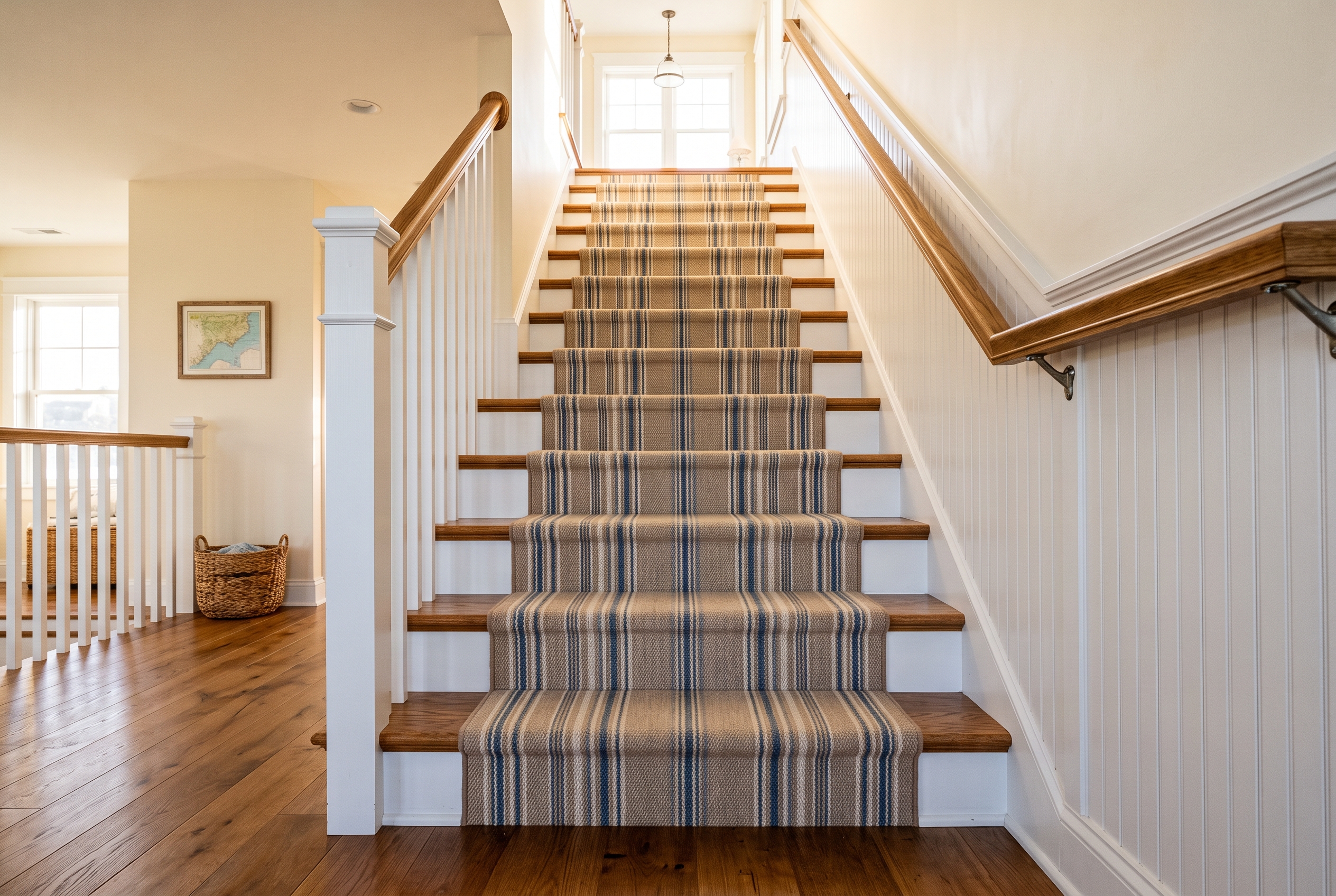
A runner over hardwood treads is where many families end up. A strip of carpet runs down the middle for grip and quiet, and wood shows on both sides. It needs treads nice enough to show. Fixr's national average for a 22-foot runner, installed, is $471 to $657 in nylon and $850 to $2,630 in wool.
Carpet stair treads, the separate rug pieces that sit on each step, are a short-term or renter's fix. They only work when every piece is held down firmly.
| What matters | Wall-to-wall carpet | Hardwood treads | Runner over hardwood |
|---|---|---|---|
| Grip underfoot | Good when tight on every step | Slippery in socks and for paws | Good down the center |
| If someone falls | Softest landing | Hardest landing | Soft in the center |
| Seeing each step edge | Softer, can blur | Crisp and clear | Clear at the sides |
| Noise | Quietest | Loudest | Quiet |
| Sand and pet hair | Hides it and holds it | Shows it, sweeps off | Runner holds it, sides sweep |
| What it needs underneath | Any sound stair | New or refinishable treads | Treads nice enough to show |
| Later upkeep | Replace when the edges wear | Recoat or refinish | Replace runner, keep treads |
This guide follows the order you would decide in. First comes what is under your carpet, then safety, then a section each on carpet, hardwood treads and runners. After those come dogs, noise, sand and cleaning, then national costs, a household-by-household table, who does this work around Wilmington, and common questions.
Look Under Your Stair Carpet Before You Choose
Before you compare finishes, pull back the stair carpet at the back corner of one step, where a small lift will not show. The tread under it, the flat part you step on, sets your options. A finished hardwood tread can be shown again. A rough tread built to be covered cannot, so your choice becomes carpet or new hardwood treads.
- If you see solid hardwood, usually oak, with a rounded front edge that is part of the same board, you can refinish it and leave it bare or add a runner.
- If you see plywood, particleboard or strand board, the panel that looks like pressed wood chips, the stairs were built for carpet. Plan on carpet or new treads.
- If you see soft framing lumber with a separate strip nailed on as the front edge, that was also meant to be covered.
- If a tread is loose, squeaks or has a cracked edge, fix it first, whatever you choose.
The repair always comes first. The carpet industry's installation standard, known as CRI 105, says treads, risers (the upright boards between steps) and front edges must be clean, dry and structurally sound before carpet goes on. The fall-prevention checklist from the Centers for Disease Control and Prevention (CDC) says to fix loose or uneven steps.
If you do find oak, expect rows of small holes. The same standard has installers fasten tack strip, a thin wood strip with angled pins that grips the carpet, across every tread. On a waterfall-style job it goes across every riser too.
Filler and refinishing hide most of those holes, and a runner covers the ones in the middle. Carpet Smart's hardwood sand and finish service is the place to ask whether your treads are worth sanding.
Are Carpeted Stairs Safer Than Hardwood?
It depends on who uses the stairs and how the finish is put down. Carpet adds grip and a softer landing, but only when it is tight on every step. Bare hardwood gives a crisp edge you can see, but it is slippery in socks and for paws. The safest stairs of either kind have a firm surface on every tread, handrails on both sides and good light at the top and bottom.
Stair falls are common enough to plan around. Researchers at the Center for Injury Research and Policy at Nationwide Children's Hospital estimated that U.S. emergency rooms treated about 1.1 million stair injuries a year from 1990 through 2012. Young children and older adults had the highest injury rates, and older adults were more likely to break a bone.
The home fall-prevention checklist for older adults from the Centers for Disease Control and Prevention (CDC) does not choose carpet over wood. It chooses secure over loose. If the carpet on your steps is loose or torn, it says to fasten it firmly to every step, or to remove it and put non-slip treads on the stairs. It also asks for handrails on both sides that run the full length of the stairs, a light with switches at the top and bottom, and nothing left sitting on the steps.
Carpet gives grip and cushion if it is tight
Carpet's two advantages on stairs are friction and cushion. A foot that lands a little short still has something to grip, and a fall onto padded steps hurts less than a fall onto oak. Problems start when the carpet is loose, worn thin at the front edges, or laid over a pad so soft that each edge feels round and mushy underfoot. Tight, thin and firm is the safe version of stair carpet.
Bare wood gives a clear edge but little grip
A bare hardwood tread has a sharp, visible edge, which helps you place your foot. Its weakness is traction. Socks, smooth slippers and dog paws slide on a finished tread, and a slip on wood ends on a hard edge. The usual fix is a runner. Non-slip treads are the CDC's answer for stairs whose carpet has come up.
Busy patterns make stairs harder to read
Busy patterns on stair carpet or a runner can hide where each step ends. In a 2021 study in the journal Human Movement Science, young and older adults walked down a seven-step stair covered in different designs. Plain steps lowered anxiety and, for most people, gave their feet more room over each edge.
The busy patterns made the walk down slower and more demanding. The researchers recommend plain steps with a contrasting strip marking each edge.
Steep stairs in North Carolina homes
North Carolina's residential code lets a riser be as tall as 8 1/4 inches, according to the Office of State Fire Marshal. The International Residential Code, the national model, caps risers at 7 3/4 inches. So stairs in North Carolina homes can be steeper than the national norm. To check yours, measure straight up from the front edge of one tread to the front edge of the next. Anything over 7 3/4 inches is steeper than the national model allows.
On a steep stair with a shallow tread, a thick carpet and soft pad can eat into the space your foot needs. People who know stairs disagree about the fix. Interior designer Victoria Kirk told the design site Remodelista that she prefers bare wood on her own very steep, narrow stairs, because carpet there makes her afraid of sliding. She said deeper treads are fine with carpet.
The safest choice for older adults
For an older adult or anyone unsteady, choose tight carpet on a thin, firm pad, or a runner over hardwood. Then add what the CDC asks for: rails on both sides and lights at both ends. The one setup to avoid is bare, slick wood with nothing added for grip. If your stairs are steep, keep whatever covers them thin and firm so each front edge stays crisp.
When Carpet Is the Right Choice for Stairs
Wall-to-wall stair carpet covers every tread and riser from one side of the stairs to the other. It is the right choice when the treads were built to be covered, when the stairs run past bedrooms, or when someone needs grip and cushion on every inch of every step. It is also the budget choice when the treads underneath would otherwise need replacing.
Choosing carpet that holds up on stairs
Carpet for stairs has to survive being bent over the front edge of every step. That bend opens up a loose or thin pile and shows the backing. So pick a dense carpet with a low to medium pile and tightly twisted yarn, which springs back, rather than a deep, plush one. A tight, low loop such as a berber wears well, but a large open loop can catch a dog's nail.
Color matters as much as construction on stairs. Medium tones and flecked colors hide the lint and grit that collect on each step. You can browse carpet styles to shortlist colors, and the About Carpet buyer's guide explains fibers and pile types in more depth.
Two installation details are worth asking about. The carpet industry's CRI 105 installation standard notes that most carpet makers want the pile to run down the stairs. It also has installers wrap the pad over the front of each step, on a front edge rounded enough that it will not cut the carpet.
The pad under stair carpet
The pad under stair carpet should be thin and firm, not thick and soft. Mohawk's residential carpet warranty asks for a pad of at least 5 pounds per cubic foot, 3/8 to 1/2 inch thick. For berber carpet it wants at least 8 pounds and 1/4 to 3/8 inch. Mohawk warns that a pad that is too soft hurts carpet performance, and one that is too thick makes the carpet hard to hold in place.
The industry standard sets a slightly lower ceiling. CRI 105 caps residential pad at 7/16 inch, a hair under Mohawk's 1/2 inch. On stairs, stay at the thin end of either range. A firm, thin pad keeps each front edge feeling solid under your foot.
Waterfall or Hollywood installation
A waterfall installation lets the carpet drop straight down from the front edge of each step to the next tread, like a curtain. A Hollywood installation, also called cap-and-band, French cap or upholstered, wraps the carpet tightly around the front edge and tucks it under. The standard has installers fasten tack strip on the risers for a waterfall job and leave it off for a cap-and-band job. Hollywood looks more tailored, takes longer and uses a little more carpet, so it usually costs more.
How long stair carpet lasts, and the warranty fine print
Stairs take hard wear, so carpet makers write separate warranty terms for them. Mohawk's residential warranty covers stairs in its top tier, and buying Mohawk's SmartCushion pad with new Mohawk carpet extends the abrasive-wear warranty, the coverage for carpet wearing thin, to stairs. Under Mohawk's standard terms, appearance changes on stair carpet are not covered. Shaw posts a separate 20-year warranty document with stairs in its name on some carpet lines.
So before you choose a stair carpet, ask two things. Does its warranty cover stairs, and which pad does that coverage require? Keep the receipts for both. When stair carpet wears, it goes first at the front edges, and a denser carpet holds up longer there.
Replacing Stair Carpet With Hardwood Treads
Hardwood stair treads are solid wood steps with a rounded front edge, stained and finished to suit your floors. Replace stair carpet with them when you want wood running up the stairs, when sand and pet hair need to sweep off in seconds, or when you are tired of replacing worn stair carpet. They cost the most up front, and they need a plan for grip.
New treads or cap treads over the old ones
There are two ways to put hardwood on stairs that were carpeted. Full replacement takes out the old treads and puts in new ones, often with new risers. A cap tread, also called a retrofit tread, is a thinner hardwood tread fastened over the old one after its front edge is cut back. Caps mean less demolition, but they change the height of your steps.
North Carolina's code measures stairs without carpet, rugs or runners, but a wood cap counts as part of the stair. A cap adds its thickness to every tread. That makes the bottom step taller and the top step shorter, unless the floors at either end change too.
The code allows no more than 3/8 inch between the tallest and shortest riser in a flight. It lets the top and bottom risers of indoor stairs run up to 3/4 inch over the shortest. So any cap-tread job starts with measuring the first and last step.
Matching the treads and risers to your floors
Carpet Smart installs custom hardwood stair treads in red oak, white oak, hickory, French oak, Brazilian cherry and more. Each tread is cut, fit and finished, with custom staining and matching risers available. The simplest matched look is the same species as your floor, stained to match. If your floors are wood, the hardwood catalog shows the species and colors your treads can be matched to.
When the floors around your stairs are luxury vinyl or laminate
Many coastal homes have luxury vinyl plank downstairs with a staircase in the middle of it. You have two good options. Hardwood treads can be custom stained to sit comfortably next to the plank color, or you can use vinyl stair treads made for your floor.
COREtec, one of the luxury vinyl brands Carpet Smart carries, makes one-piece vinyl stair treads with the front edge attached, designed to match its planks. Ask whether your plank's collection has a matching tread before you decide.
Keeping hardwood treads from being slippery
Bare treads need a grip plan, especially with older adults, toddlers or dogs in the house. A runner is the most complete fix, and non-slip treads are the CDC's suggestion. Clean treads grip better than gritty ones, so follow the National Wood Flooring Association's routine: sweep or dust-mop daily and vacuum weekly on the bare-floor setting. When the finish looks dull, a recoat, a fresh coat of finish, renews it.
Hardwood treads in a humid coastal house
Solid wood swells when it takes on moisture and shrinks when it dries. The National Wood Flooring Association asks homeowners to keep the house at 60 to 80 F and 30 to 50 percent relative humidity all year. Floors that gain moisture cup, and floors that lose it gap or split.
Outdoors, Wilmington's relative humidity averages 74 percent over the year and about 80 percent in August, according to the National Weather Service. So if your second home sits closed up all summer, leave the air conditioning or a dehumidifier running.
Adding a Stair Runner Over Hardwood Treads
A stair runner is a strip of carpet or woven rug fastened down the middle of the stairs, with wood showing on each side. It gives you most of carpet's grip and quiet and most of wood's looks. Choose it when your treads are nice enough to show but the stairs are too slippery, too loud or too hard on the dog. A worn runner can be replaced later without touching the treads.
What a runner needs underneath
A runner needs good-looking treads, because the wood at each side stays on show. It also needs a pad. The design site Remodelista reports that runners usually go over a pad, which cuts noise and protects the runner from wear, and that hidden staples, or sometimes tack strip, hold both in place. Keep that pad thin and firm, for the same reasons as under wall-to-wall carpet.
How wide a stair runner should be
On stairs three to four feet wide, interior designer Victoria Kirk recommends leaving about three or four inches of wood showing on each side of the runner. On a five-foot stair she widens the gap to about seven inches. A wider runner looks more traditional, and a narrower one shows off more wood. To find your width, measure a tread from side to side and subtract twice the gap you like.
Waterfall or Hollywood for a runner
Runners use the same two installations as wall-to-wall carpet. Kirk's rule of thumb is to use a waterfall where a quarter-round molding, the small curved trim, sits under the front edge of each tread, so the runner falls cleanly over it. Where there is no molding, she uses the tighter Hollywood wrap.
Either way, a runner cut from carpet needs its long edges bound so they do not fray, and the carpet industry's CRI 105 standard requires exposed edges on stair carpet to be sealed.
Landings, winders and turns
A straight staircase is the simplest runner job. A landing needs its own piece or a mitered turn. Winders, the wedge-shaped steps on a turning stair, need each piece cut and bound to its shape. Fixr's national estimate puts runner installation alone at $295 to $395 for a straight run and $395 to $495 when landings or winders are involved.
Do stair runners need rods?
No. Stair rods, the metal bars across the back of each step, are decorative today, and staples do the holding. Kirk calls them purely decorative. Add them if you like the look, and skip them if you want a clean line.
Color and pattern for a runner
For runner color, Kirk steers clients toward a medium tone, since dark runners show lint and light ones show dirt and scuffs. On pattern, she warns against bold, high-contrast geometric designs that make it hard to see where the next step is, which lines up with the Human Movement Science study. Vertical stripes, solid colors and quiet tonal patterns keep every edge easy to read.
Runner or carpet stair treads?
It depends on how long you want it to last. Carpet stair treads are separate rug pieces, one per step, usually held with tape, adhesive or a grippy backing. They cost less, lift out for cleaning and suit a rental or a trial run. They also leave bare wood at the front of each step, and they can shift. The CDC's rule for stair carpet applies to them too: every piece must be firmly attached.
Carpet Smart makes custom stair runners and hallway runners in custom sizes, and its carpet binding is done in-house. Its post on custom rugs and carpet binding in Wilmington explains the edge finishes and how binding is priced.
How Each Finish Handles Dogs, Noise, Sand and Cleaning
Dogs on the stairs
For a dog, a runner or wall-to-wall carpet beats bare wood. Cornell University's College of Veterinary Medicine lists trouble with stairs among the signs of arthritis in dogs, and non-slip rugs among the ways to help at home. Full carpet gives grip on every inch of the step, while a runner leaves bare wood at the sides, so choose full carpet if your dog tends to use the edges.
If your dog hesitates at the top step, traction is the fix. Pick a dense cut pile or a tight low loop so claws do not catch, and keep nails trimmed so they grip instead of skating.
Which stair finish is quietest
Carpet is the quietest stair finish, a runner comes close, and bare wood is the loudest. The Carpet and Rug Institute says carpet absorbs sound in the room, cuts the noise footsteps make on the surface, and reduces the thud carried to rooms underneath. In its tests, a pad under the carpet raised sound absorption further. In a two-story house with bedrooms beside the stairs, you will hear the difference every morning.
Sand from the beach
Near the beach, sand decides how fast any stair finish wears. On hardwood, the National Wood Flooring Association says tracked-in dirt dragged across the floor wears the finish, and it recommends rugs at doorways. On carpet, the Carpet and Rug Institute says soil left in the pile damages the fibers and shortens the carpet's life, and it recommends vacuuming high-traffic areas daily.
In a beach house, that means mats at every door and more stair vacuuming than feels necessary. In a rental, add a boot tray and a shoes-off sign by the door, and vacuum the stairs at every turnover. A runner is the forgiving choice for sand, because you replace the runner and keep the treads.
Cleaning each finish
Hardwood treads are the easiest stairs to clean. Sweep or dust-mop them, and skip wet mops and steam mops, which the National Wood Flooring Association says damage the finish and the wood over time. Carpet takes the most work, since you vacuum each step by hand and blot spills before they soak in. A runner splits the difference, with the wood edges wiping clean and the runner vacuumed like carpet.
What Each Stair Finish Costs
Carpeting the stairs and adding a nylon runner cost about the same up front in Fixr's national figures, a wool runner costs more, and new hardwood treads cost the most. A runner's price assumes the treads under it are already good enough to show. These are national estimates from two cost guides that explain how they gather prices, so your local price and your staircase's shape will move them.
| Stair finish | National estimate | Source and date |
|---|---|---|
| Wall-to-wall carpet | $430 to $780 for 12 straight stairs | Fixr, January 2025 |
| Nylon runner, 22 feet | $471 to $657 installed | Fixr, January 2025 |
| Wool runner, 22 feet | $850 to $2,630 installed | Fixr, January 2025 |
| Hardwood treads | $100 to $300 per stair installed | HomeAdvisor, June 2026 |
HomeAdvisor builds its numbers from surveys of customers after their projects. It puts a typical hardwood stair job at $1,800 to $6,300 and adds $150 to $1,560 for carpet removal and repairs underneath. If you plan cap treads, budget for the work at the top and bottom step too.
Fixr draws on pricing databases, contractors and industry experts. It prices edge binding for a custom runner at $2 to $6.50 per linear foot, and a staircase with landings or winders costs more to fit.
Think about what you pay for again, too. Stair carpet is replaced when its front edges wear. Hardwood treads are recoated or refinished instead of replaced. A runner is replaced while the treads under it stay put.
Which Stair Finish Fits Your Household
Most households choose a runner over hardwood or wall-to-wall carpet, and bare treads suit homes where nobody needs extra grip. Find your situation in the table, then read the tie-breakers after it if two rows fit your house.
| Your household | Best fit | Why |
|---|---|---|
| Older adults or anyone unsteady | Tight carpet or a runner | Grip and cushion, plus rails and lights |
| Toddlers learning stairs | Carpet or a runner | Softer steps to crawl on |
| Dogs, especially older ones | Runner or carpet | Paws need traction on every step |
| Beach house or rental | Runner over hardwood | Wood sweeps clean; runner is replaceable |
| Wood floors you want to continue | Hardwood treads, maybe a runner | Matched stain and risers |
| Tight budget | Carpet, or a nylon runner on good treads | Lowest cost up front |
| Steep stairs, shallow treads | Thin, firm covering or bare wood | Keeps each front edge crisp |
When two rows pull in different directions, let the person or pet who is least steady decide. A wood-loving family with an aging dog should add a runner. A rental with older guests should favor a runner and rails over bare wood. If the treads under the carpet are rough, the choice narrows to carpet or new treads, and a runner can come later.
Who Makes Stair Runners and Hardwood Treads in Wilmington
Carpet Smart, a family-owned flooring store in Wilmington, North Carolina, since 1999, handles all three stair finishes. It installs carpet with professional stretching, and it makes custom stair runners and hallway runners in custom sizes, with the carpet binding done in-house. It also installs custom hardwood stair treads in red oak, white oak, hickory, French oak, Brazilian cherry and more, with custom staining and matching risers. Its stair makeovers include carpeted stairs and bound runners over wood, and the full list is on its flooring services page.
The store serves Wilmington, Leland, Hampstead, Southport and the rest of New Hanover, Brunswick and Pender counties, from its showroom at 710 S 17th St. To get a useful estimate for any of the three finishes, have these ready:
- A photo of the wood under a lifted corner of the carpet
- The number of steps, and whether there is a landing or winders
- The width of one tread and the height of one riser
- Photos of the floors at the top and bottom of the stairs
- Who uses the stairs: kids, older adults, dogs, guests
Stair Finish Questions People Ask
Can you put a runner over carpeted stairs?
No, a runner belongs on a hard, finished tread, not on top of carpet. Carpet underneath lets a runner shift and bunch, which is the loose covering the CDC checklist warns about. If the carpet has to stay, replace it. If the wood under it is good, take the carpet up and put the runner on the wood.
Do the stairs have to match the floors?
No, but the stairs should look planned. Hardwood treads stained to the floor color, a runner that picks up a color from nearby rooms, or stair carpet that matches the upstairs carpet all read as intentional. What looks like a mistake is a near miss, such as a tread stain that is almost, but not quite, the floor color.
Does carpet damage hardwood stairs underneath?
Yes, a little, but it rarely ruins the wood. Wall-to-wall stair carpet is held by tack strip fastened across every tread, and across the risers too on a waterfall job, while runners are usually stapled. Those holes can be filled, and sanding and refinishing take care of most of what is left.
Should the risers be painted or stained?
It depends on the look you want. Painted risers under stained treads are a classic look, and stained risers that match the treads look more like furniture. Painted risers show scuffs from toes sooner, which the design site Remodelista notes is one more thing a runner protects against. If you paint, choose a tough trim paint.
Is wool or synthetic better for a stair runner?
It depends on who uses the stairs and how often you expect to replace the runner. Interior designer Victoria Kirk prefers wool for its look and says she does not buy the theory that synthetics hold up better. In Fixr's national figures, though, a nylon runner costs much less than a wool one, which makes it the easier choice to replace when kids, pets or rental guests wear it out. For any fiber, a dense, low pile matters more on stairs than the fiber's name.
How much runner do I need?
To work out how much runner you need, measure the depth of one tread including its rounded front edge, add the height of one riser, and multiply by the number of steps. Then add the length of any landing and a little extra for the top and bottom. Fixr's national estimate uses about 22 linear feet for an average staircase, and landings or winders add more.
Those measurements, a photo of what is under your carpet, and a list of who uses the stairs are all it takes to price carpet, a runner and hardwood treads side by side. Request a free estimate from Carpet Smart and compare all three for your own staircase before you commit.


