

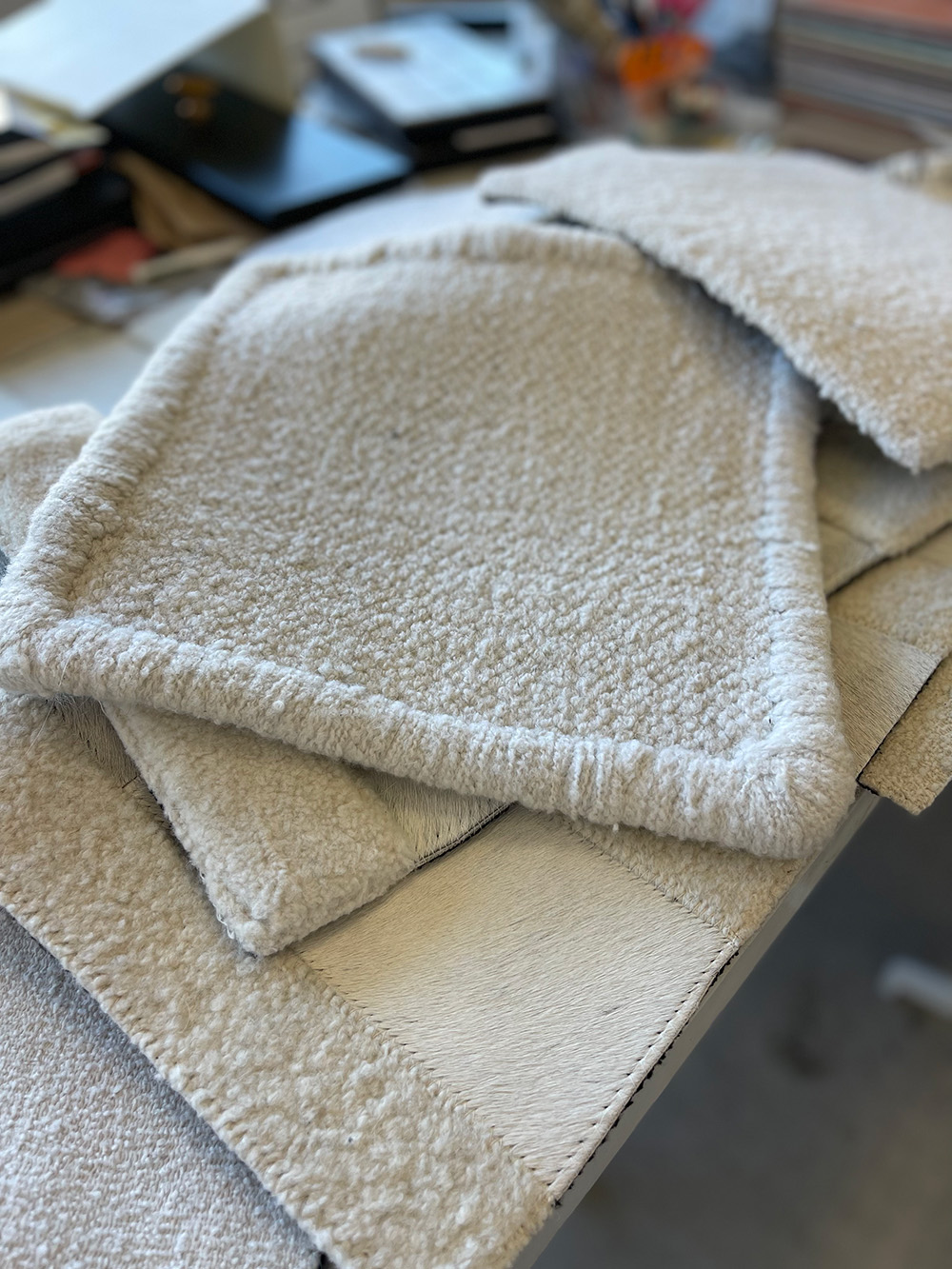
Your living room needs a 7x11 rug. The store has 5x8 and 8x10. Your hallway runs nineteen feet; the longest runner in stock is twelve. If you've hit this wall while rug shopping, there's a workshop in Wilmington built for exactly this problem: we cut and bind custom rugs in-house, from any carpet on our wall, to any size you bring us.
Here's how binding works, how to size a rug like a designer, and how a carpet remnant can get you a custom rug for a fraction of retail rug prices.
What Carpet Binding Actually Is
Cut a piece of carpet and the edge will unravel — tufts pull loose, the backing frays, and the rug slowly comes apart. Binding solves that by permanently sealing the cut edge. There are two main finishes, and you'll choose between them at the workshop:
Binding tape: A strip of fabric — usually polyester or cotton, in your choice of color — wrapped over the edge and machine-stitched down. Clean, flat, and durable; this is the classic finish on most custom rugs.
Serging: A continuous wrap of yarn stitched around the edge, giving the look of a finely finished, higher-end rug. It costs more per foot and earns it on rugs that show their edges prominently.
Because the machines live in our building, your rug never ships anywhere. Turnaround runs days rather than the weeks you'd wait on a send-away service, and you can look at binding colors against your actual carpet before we stitch a single edge.
Why Custom Beats Buying Off the Rack
A rug that fits changes how a whole room sits, and standard sizes constantly miss. With custom binding you get:
Any dimension, to the inch. Odd-shaped sunrooms, L-shaped landings, a rug cut to trace your kitchen island — if we can cut it, we can bind it.
Hundreds of materials to start from. The full carpet collection is your rug catalog: plush, textured, patterned, looped coastal weaves, indoor-outdoor olefin for porches.
A true match to your home. Bring a flooring sample or cabinet photo to the showroom and match undertones in real light, on full-size samples instead of a two-inch swatch online.
Which Carpet Makes the Best Rug?
Fiber choice matters as much for a rug as for wall-to-wall carpet. Nylon bounces back from furniture and traffic, which makes it the workhorse for living room rugs. Triexta carries built-in stain resistance that never washes off — the pick for dining rooms and households with pets. Polyester (PET) delivers rich color on a budget and suits bedrooms well. Olefin shrugs off moisture and sun, which is why it goes onto porches and into beach-house entries.
Pile height matters too: low, dense loop and textured cuts vacuum easily and shed sand fast, while deep plush feels wonderful in a bedroom and works harder to keep clean in an entryway.
The Remnant Play: A Custom Rug at Offcut Prices
Remnants are the ends of larger carpet rolls — quality material left over when a roll gets cut for a job. They're sold at a steep discount because they're fixed sizes, and they're the raw material for the best rug deal in town.
The play is simple: pick a remnant, tell us your size, and the binding workshop turns it into a finished custom rug — often for less than a mass-produced rug of the same size, in better material. Remnants move fast and change weekly, so check what's on the racks alongside our in-stock carpet, all priced under the same no-gimmicks policy as everything else in the store: aggressive from day one, no fake sale theater.
If you run a rental anywhere from Carolina Beach to Topsail, this is your play — bound remnant rugs look intentional in listing photos, survive guest season, and cost little enough to replace without wincing.
How to Size a Rug Like a Designer
Since size is the whole reason to go custom, get it right. These are the rules we measure against:
Living rooms: At minimum, the front legs of every seating piece sit on the rug. Leave a consistent 8 to 18 inches of bare floor between rug and walls so the rug frames the room instead of wall-to-walling it.
Dining rooms: The rug extends at least 24 inches beyond the table on every side. That's the number that keeps chair legs on the rug when someone slides back from dinner.
Bedrooms: Either one oversized rug reaching 18 to 24 inches past the bed on three sides, or a pair of bound runners along each side for that warm first step on a winter morning.
Entryways: Size the mat to your actual doorway traffic, in a tight low-profile weave. On our coast this rug has a job: it's the sand trap that protects every other floor in the house.
Measure with painter's tape on the floor before you come in — walk around the taped outline for a day and you'll know immediately if the size feels right.
The Rug Pad: The Cheap Part That Protects the Expensive Parts
Every custom rug we bind should go home with the right pad under it. A quality felt-and-rubber pad keeps the rug from creeping, adds cushion, and extends the rug's life by absorbing the grinding between rug backing and hard floor.
One warning from the workshop: skip the bargain-bin PVC waffle pads. On vinyl and finished hardwood, the plasticizers in cheap PVC can react with the floor's finish over months and leave a permanent dull imprint. If you've just invested in new luxury vinyl plank or refinished wood, that ten-dollar pad is the most expensive thing you can put on it. We stock pads that are safe for every floor we sell.
What Custom Binding Costs
Binding is priced by the linear foot of edge, so the perimeter of your rug — how much edge needs sealing — matters more than its area. A 6x9 rug has 30 feet of edge; a long 3x19 hallway runner has 44, which is why a skinny runner can cost more to bind than a bigger rectangle.
Three things move the total: the carpet you start from (remnant versus fresh cut from a roll), the edge finish (binding tape versus serging, which runs higher), and the pad. Bring your measurements to the counter and you'll have a real number in minutes — the same no-gimmicks pricing as everything else in the store, with no minimum order that forces you into a bigger rug than your room wants.
Keeping a Bound Rug Looking New
A custom rug earns its keep for years with a few habits worth building from day one:
Vacuum with the edges in mind. Run the vacuum along the bound edge rather than across it, and keep the beater bar on a height setting that agitates the pile without chewing the binding.
Rotate the rug 180 degrees once a year. Coastal sun through sliders and big windows fades fibers unevenly, and traffic wears paths. Rotation spreads both so the rug ages as one piece.
Blot spills, never scrub. Scrubbing works a stain deeper and frays pile. Blot from the outside of the spill inward, and match your cleaner to the fiber — we'll tell you which product suits the carpet you chose.
Give it a professional clean every year or two. Bound rugs have an advantage over wall-to-wall here: they can leave the house for a deep clean and come back like new.
Stair Runners: The Custom Job That Pays for Itself
Bare wood stairs are slippery when your socks meet them, loud when the kids take them at a run, and hard on dogs who've learned to fear them. A custom stair runner fixes all three: traction underfoot, a real drop in footstep noise, and protection for the treads themselves.
We cut, bind, and install runners fitted to your staircase's exact dimensions — straight runs, landings, and winders — as part of our in-house flooring services. Matching hallway runners can be bound from the same roll so the look carries through the upstairs.
Start With a Tape Measure and a Visit
Bring your measurements — or your questions — to the showroom at 710 S 17th Street and walk the carpet wall with us. You'll get binding options priced on the spot and a finished rug within days. Directions and hours are here, or request a free estimate and call (910) 362-9700 with any question about sizes, fibers, or what's on the remnant racks this week. We've been binding rugs for Wilmington, Leland, Hampstead, Southport, Burgaw, and the beach towns since 1999 — one perfectly fitted rug at a time.


