

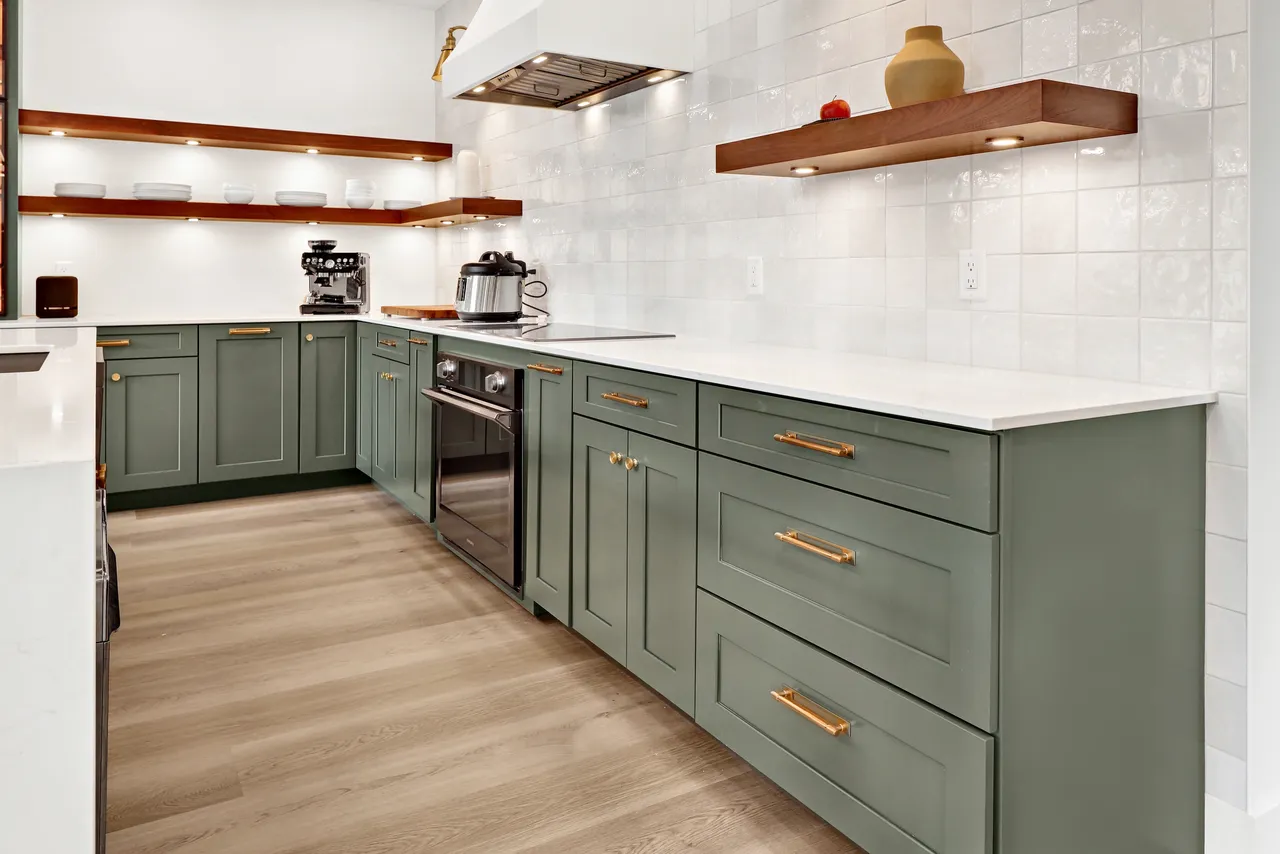
When you update flooring without replacing cabinets or painted woodwork, the room can feel a little like a puzzle. You want everything to relate, but you do not want the floor to disappear into the background or fight for attention. The good news is that laminate is flexible enough to bridge old and new finishes—as long as you look at undertones, contrast, and texture before you fall in love with a single plank.
Start with undertones, not color names
“Gray,” “brown,” and “natural” sound helpful, but those labels do not tell you enough. What matters more is the undertone running through your cabinets and trim. Oak may lean golden, espresso cabinetry can read red, and white painted millwork often carries either a creamy warmth or a cooler crispness. If the floor pulls in a completely different direction, the room can feel off even when each individual finish looks attractive on its own.
A simple trick is to compare samples in daylight and at night with your actual woodwork nearby. In many homes around Wilmington, NC, changing light throughout the day can shift how warm or cool a floor appears, so a sample that looks balanced at noon may feel too gray by evening. That is where a broader laminate selection helps, because seeing more tones side by side makes those subtle differences easier to spot.
Decide whether you want contrast or continuity
Once the undertones make sense together, decide how much separation you want between the floor and the built-ins. If your cabinets are medium brown, choosing a nearly identical plank can make the whole room blur together. A floor that is a few shades lighter or darker usually creates more definition and gives the trim something to frame.
That does not mean high contrast is always better. In smaller rooms, especially those with a lot of visual breaks already, a quieter transition can feel calmer and more intentional. If you are comparing laminate to other hard-surface looks for adjoining spaces, it can also help to review hardwood options so you can judge how much natural variation you want the room to show.
Let texture do some of the work
Color gets most of the attention, but texture often determines whether the combination feels believable. Smooth painted trim pairs well with cleaner, more refined visuals, while rustic cabinetry can support a floor with stronger graining and more movement. If both surfaces are busy, though, the room starts to feel crowded.
This matters even more in coastal homes near Wrightsville Beach, where bright natural light tends to reveal every detail. A heavily patterned plank next to dramatic cabinet grain can become too much very quickly. If you want help picturing how different surfaces play together before making a final call, the design inspiration galleries are useful for seeing how tone and texture balance across real rooms.
Think about the rest of the house, too
A floor does not live in isolation. It connects one room to the next, which means your cabinet-and-trim decision should also support the spaces beyond the kitchen or bath. That is one reason laminate works so well in busy households in places like Leland: it can coordinate with painted millwork in one area and transition gracefully toward softer finishes elsewhere.
If nearby rooms include textile-heavy spaces, it is smart to compare your hard-surface choice against a broader carpet selection or even luxury vinyl collection for adjacent zones. Seeing those materials together can keep the whole home from feeling pieced together one room at a time.
Pull it all together with real samples
The best laminate choice usually is not the one that shouts the loudest in the showroom. It is the one that makes your cabinets, trim, wall color, and lighting feel like they belong in the same conversation. Match undertones first, use contrast with purpose, and let texture support the look instead of overpowering it. When you are ready to compare options against your actual space, you can schedule your free in-home consultation.


