

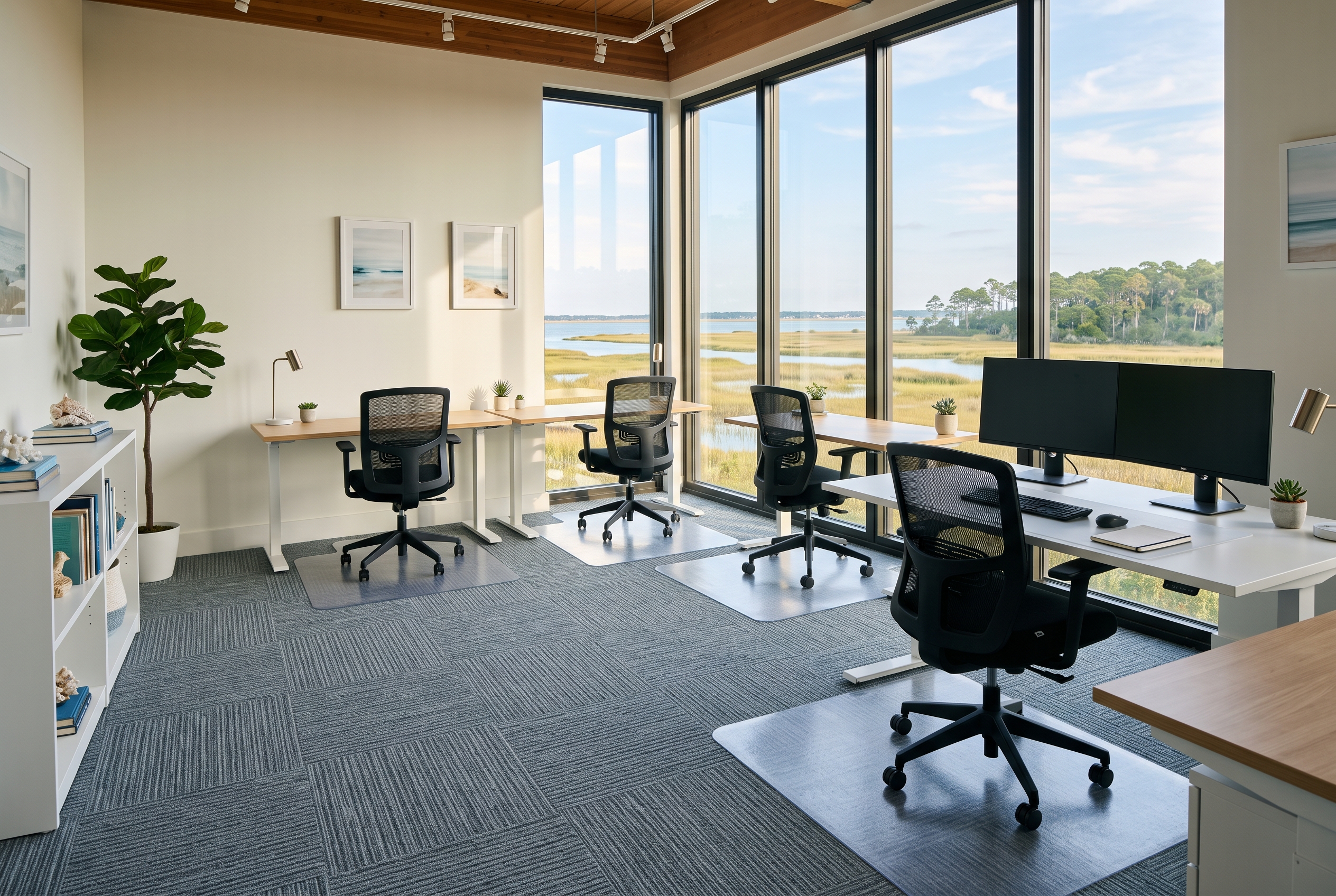
Choose carpet tile where parts of the floor will need lifting, replacing or working around, and choose broadloom where first cost, softness and one continuous floor matter more and the room is simple. Most commercial buildings end up with some of each, because a busy office corridor and a quiet rental bedroom ask different things of a carpet.
Offices are where carpet tile works best. Tiles can go in overnight while desks are jacked up rather than moved out, a stained tile under a chair can be swapped out, and tiles lift for access to cabling. A boardroom can still go in broadloom, and clinics with carpeted corridors need a corridor fire rating.
Apartments and long-term rentals usually get the best value from broadloom over a pad inside the units, where it is softer and cheaper to install. Carpet tile belongs in the hallways and common rooms that take the heaviest traffic.
Vacation rentals near the beach need a solution-dyed fiber, a real entry-mat routine and air conditioning that runs while the house is empty. Broadloom suits the bedrooms, and tile suits a bonus room or the area inside a beach door.
Shops and retail stores on concrete slabs are usually better off in carpet tile. Some tile systems are approved over damper slabs than glue-down broadloom, worn tiles by the door and register can be replaced without closing, and a low loop tile meets the ADA's carpet rules.
On most jobs the decision comes down to cost, repairs, downtime, looks and the slab. The moisture limits in the table are Aladdin Commercial's, one of the commercial brands we carry.
| Factor | Carpet tile | Broadloom |
|---|---|---|
| Up-front cost | Usually higher per square foot | Usually lower; add pad if stretched |
| Repairs | Swap the damaged tiles | Patch, or replace the room |
| Installation disruption | Often overnight, furniture lifted | Room cleared first |
| Look | Visible grid of seams | One continuous floor |
| Comfort | Firm; cushion-back options | Softer over a pad |
| Damp concrete slabs | Some systems approved over 95% RH | Glue-down limit 80% RH |
| Stairs | Not recommended | Yes |
The page runs in this order. First, what the two formats are and what makes carpet commercial grade. Then a factor-by-factor comparison, the best choice for offices and clinics, apartments, vacation rentals and shops, and how to mix formats in one building. After that come the rules commercial carpet must meet, the spec sheet, cleaning, planning, who installs commercial carpet locally, and common questions.
What Carpet Tile and Broadloom Are
Broadloom is carpet made in rolls, and carpet tile is carpet cut into pieces at the mill with its backing already attached. That is how the Carpet and Rug Institute (CRI), the carpet industry's trade association, defines them in CRI 104, its standard for installing commercial carpet. The face yarn can be identical. What differs is the size of the piece, the backing and how it is held to the floor.
How broadloom goes down
Broadloom comes off a roll, and almost all roll carpet sold in the United States is 12, 13.5 or 15 feet wide, with 12 feet the standard, according to CRI's reference guide, The Carpet Primer. Any room wider than the roll needs a seam. Six-foot rolls exist too, and CRI notes they help in high-rise buildings and narrow halls, where a 12-foot roll is hard to move, at the price of more seams.
Commercial broadloom is installed one of three ways. Stretch-in carpet is pulled tight over a separate pad and hooked onto tack strips, the way most homes are carpeted. Direct glue-down carpet is glued straight to the floor, and CRI calls it the usual specification where rolling equipment and heavy traffic are expected. Double glue-down glues a cushion to the floor and the carpet to the cushion, and CRI 104 limits that cushion to 3/8 inch thick.
How carpet tile is held in place
Carpet tile most often comes as 24-inch squares, and 12-by-36-inch planks are common too, both covered in Aladdin Commercial's installation guide. The backing is built in, so there is no separate pad, and cushion-back tiles add a bonded cushion layer for more comfort.
Tiles are held down lightly on purpose. CRI 104 describes a thin film of pressure-sensitive adhesive that dries before the tiles go down, then keeps them from sliding while still letting each one lift out. CRI lists the other methods as releasable adhesives, peel-and-stick backs applied at the mill and floating systems. Aladdin also sells adhesive tabs that join tiles at the corners.
The way tiles are turned sets the look. Monolithic installation points every tile the same way, quarter-turn rotates each tile 90 degrees from its neighbors, and ashlar offsets each row, which Aladdin says must be by a third of a tile. Random installation mixes tiles from several boxes to blend color. Aladdin adds that tile in an ashlar layout will not look the same as the same carpet as 12-foot broadloom.
What makes carpet commercial grade
Commercial carpet is built and tested for loads that home carpet never sees. It is usually a low, dense pile, often a level loop, on a backing made to be glued down. Its spec sheet reports tests a residential label skips, including tuft bind, backing strength, static and, for corridors, a fire rating.
CRI's Primer gives the thresholds. Tuft bind, the force needed to pull a loop out, should be at least 10 pounds for loop pile, and the secondary backing should resist peeling at 2.5 pounds per inch or more. In public spaces, the ADA limits carpet pile to 1/2 inch. A thick, plush residential carpet can fail all three.
Carpet Tile vs Broadloom, Factor by Factor
Carpet tile and broadloom trade off on eight practical points: cost, repairs, downtime, seams, comfort, rolling loads, slab moisture and warranties. Each business weighs them differently, and the space-by-space advice after this section draws on them.
Up-front cost and what drives it
Carpet tile usually costs more to buy and install per square foot than broadloom of similar quality. CRI's Primer says the lower disruption of a tile installation can make up for that extra cost. Online price comparisons disagree because they compare different carpets, so compare quotes for the same carpet in both formats.
Several things push each format's cost up or down. Broadloom stretched over a pad adds the pad, which HomeAdvisor's June 2026 cost guide puts at $0.75 to $2 a square foot nationally. Broadloom also comes in 12-foot widths, so a room that is not a multiple of 12 feet leaves offcuts, and a patterned broadloom has to be matched across seams.
Tiles fit odd shapes with little leftover and need no pad, and they can often go in without clearing the space, which is where CRI sees the savings. HomeAdvisor's guide, based on surveys of customers after their projects, puts installed carpet at $3 to $11 a square foot nationally, with old-carpet removal at $1 to $5. That guide covers homes, so treat it as the range for rental units. We could not find a survey-based source that splits commercial costs by format.
Repairs, stains and worn areas
For repairs, carpet tile's biggest advantage in a business is that a stained or burned tile comes out and a new one goes in. Aladdin's instructions say replacements can come from spares kept on site or from an out-of-the-way part of the installation. A new tile looks different at first, and the difference usually fades soon.
Tiles can also be rotated. The Primer notes that moving tiles from heavy traffic lanes to quiet corners is an alternative to replacing a whole broadloom floor. Damaged broadloom is repaired by cutting in a patch from a leftover piece, which hides best on solid colors.
Buy spare tiles with the original order. Aladdin's warranty excludes differences between dye lots, so tiles bought years later may not match the floor.
Installation time and business downtime
Carpet tile is the format for a business that cannot close. CRI's Primer describes offices where panels and furniture are lifted with a jack while tiles go underneath, so an entire office can often be recarpeted in one overnight shift instead of being disrupted for days. Broadloom needs the room cleared of furniture first.
Traffic after installation is a separate question. CRI 104 recommends keeping everyone but installers off adhesive spread on site for 24 to 48 hours, and Aladdin asks for at least 24 hours before furniture and heavy traffic return to glue-down broadloom. Tab systems and mill-applied peel-and-stick backs put no wet adhesive on the floor, so ask your installer how soon traffic can return for the system you choose.
Either way, CRI 104 asks that carpet be the last trade on the job, after the painting and other work are done.
Seams and the finished look
For the finished look, broadloom gives one continuous floor and carpet tile never quite does. Every tile edge is a seam, and on some products the grid shows. Designers use that on purpose, mixing colors, running pathways through a space or laying planks in herringbone.
Broadloom has fewer seams, but they are long, and CRI 104 sets rules for placing them. Seams should run the length of the room and along the main traffic flow, away from spots where people pivot, not straight across a doorway and not where sunlight rakes across them. Patterns add a challenge, since Aladdin's tolerances allow up to 1 1/2 inches of bow or skew across a 12-foot width.
Comfort, warmth and sound
For comfort, broadloom over a good pad is the softer floor, which is why it stays popular in apartment bedrooms and conference rooms. Carpet tile with a standard hard backing feels firmer underfoot, and cushion-back tiles sit between the two.
Firmness helps in public buildings. The US Access Board's advisory to the ADA standards explains that firmer carpet takes less effort to roll a wheelchair across, and it prefers no pad where accessibility matters. For sound, CRI, which promotes carpet, says carpet absorbs far more airborne noise than other floor coverings and nearly eliminates footfall noise. Both formats deliver that.
Rolling chairs, carts and heavy loads
Rolling loads need a carpet held firmly to the floor. CRI's Primer names direct glue-down as the usual specification where rolling equipment and heavy traffic are expected, and stretch-in carpet over a soft pad is the wrong choice under desk chairs and carts.
Carpet tile handles rolling chairs if you follow the maker. Aladdin recommends chair pads under chairs with roller casters, with flat, round casters 5/8 to 1 inch wide. Without chair pads, it says, tiles lose their appearance sooner and may shift, and its tile warranty points to chair pads as the way to prevent delamination.
Concrete slabs and moisture
If your shop or office sits on a concrete slab, the moisture in that slab may decide the format for you. CRI 104 requires a written report on slab moisture and alkalinity before any glue-down or floating tile installation. It recommends independent testing, because skipping it often ends in failure and can void the warranty.
The two usual tests are an in-slab relative humidity probe (ASTM F2170) and a calcium chloride test of the moisture coming off the surface (ASTM F1869). Aladdin's broadloom instructions cap slab moisture for glue-down at 80 percent by the probe test, and they note that new concrete generally takes 90 to 120 days to cure.
Its carpet tile guide is more permissive for some products. Certain tile backings can be glued at readings under 95 percent, and its adhesive tabs are approved over 95 percent when there is no visible moisture. Other tile backings in the same guide need a sealer from 80 to 90 percent.
So on a damp coastal slab, a tile system approved for high moisture can go where glue-down broadloom cannot. That approval covers the carpet, not the building. A slab with standing water or a leak needs the cause fixed first.
Lifespan and warranties
Commercial carpet warranties promise against specific failures rather than a number of years of looking new. CRI's Primer lists the usual items as wear, static, tuft bind, edge ravel, dimensional stability and staining. Aladdin's lifetime tile warranty, for example, says tiles will not lose more than 10 percent of their pile weight to abrasive wear or build static over 3.5 kilovolts.
The same warranty covers edge ravel, delamination and dimensional stability, and its exclusions matter as much as its promises. It requires Mohawk's adhesives and floor preparation, and it excludes floods, excess slab moisture, stairs, improper cleaning, fading, pile crush and dye-lot differences. Aladdin's ten-year stain warranty adds its own condition: the owner must try to remove a spill within three working days with the cleaners Mohawk recommends.
The Best Choice for Offices and Clinics
Carpet tile is the better choice for most offices. It goes in with the least disruption and handles rolling chairs when glued properly and paired with chair pads. It also lets you replace the worn tiles in front of the coffee station without touching the rest. And it lifts for access where cabling runs under a raised floor, a common use CRI notes for tile.
Think of an office in zones. Open workstations and corridors take rolling chairs and constant traffic, so they suit a glued loop tile with chair pads. Private offices can take either format. Conference rooms and executive offices are where broadloom's continuous look pays off, because they see little rolling traffic. Break rooms and entries with water belong in a hard surface, with the carpet stopping at a proper transition.
You are moving a 20-person office into a second-floor suite and can close for one weekend at most. Order tile early, have the floor tested, and plan for the tiles to be down a day or two before staff return. Specify a level loop or a tight, low cut pile in solution-dyed nylon, a static rating of 3.5 kilovolts or less, and chair pads for every rolling chair. You can compare Aladdin Commercial, Pentz and Philadelphia Commercial tiles in our carpet tile catalog.
Medical and dental offices follow the same logic with two additions. Carpeted corridors need the fire rating covered in the rules section, and rooms full of sensitive equipment may need a lower static limit. CRI's Primer treats 3.5 kilovolts as usually acceptable for general commercial areas and 2.0 kilovolts as the accepted limit for more critical ones. Carpet tile suits a waiting room, where spills are likely and one stained tile can be replaced between patients.
The Best Choice for Apartments and Long-Term Rentals
Inside apartment units, broadloom over a pad is usually the better value. It costs less to install and feels softer in bedrooms. Carpet tile earns its place in the common areas, the hallways and community rooms that take a building's heaviest traffic and wear out in lanes.
The arithmetic is simple. A unit with 450 square feet of carpet at HomeAdvisor's national range of $3 to $11 a square foot installed comes to roughly $1,350 to $4,950 before removal of the old carpet. Across dozens of units, the gap between a basic and a durable carpet matters more than the gap between formats.
You manage 36 older apartments with tired bedroom carpet and frequent turnover. Replace unit carpet in broadloom with a durable nylon or solution-dyed fiber, keep one style across the property so leftover pieces can patch any unit, and put carpet tile in the corridors. In units with pets, follow CRI's advice to vacuum pet areas daily. Our guide to carpet fibers, pile types and padding covers the residential choices in more depth.
Carpet tile can make sense inside a unit where the same spot is ruined at every move-out, such as the area in front of a sliding door. Kitchens, baths and entries in rental units are better in a resilient floor than any carpet, and our article on budget-friendly vinyl flooring for rental properties covers those rooms.
The Best Choice for Vacation Rentals at the Beach
A vacation rental near the beach needs carpet that shrugs off sand, sun and weekly turnovers. Choose a solution-dyed fiber, which CRI's Primer credits with outstanding fade resistance and colorfastness, in a low, dense construction that gives up sand to a vacuum. Broadloom suits the bedrooms, and carpet tile suits a bonus room or the area just inside a beach door.
For the fiber itself, CRI's descriptions point the way. Solution-dyed nylon, which CRI calls durable, resilient and abrasion-resistant, belongs in the busiest rooms. Where traffic is lighter and cost matters, solution-dyed polyester, which resists water-soluble stains, or olefin, which resists fading, moisture and stains and is favorably priced, can serve a bedroom well.
Sand is the main enemy. Put a scraper mat at the porch and a washable mat inside the door, and vacuum at every turnover. CRI recommends daily vacuuming in high-traffic areas and a professional deep clean every 12 to 18 months.
Humidity comes next. Wilmington's outdoor air averages 68 to 80 percent relative humidity by month, according to the National Weather Service. CRI 104 caps indoor humidity at 65 percent from 48 hours before an installation until 72 hours after, so schedule new carpet with the air conditioning running, and keep it running while the house sits empty.
Then there is storm water. The EPA warns that mold can grow on carpet that stays wet for more than 24 hours, and Aladdin's tile warranty, like most, excludes floods. If water gets in, act the same day. With tile, only the soaked area may need replacing if the rest stayed dry.
The Best Choice for Shops and Retail Stores
Carpet tile is the better choice for most shops. Retail floors wear hardest at the door, the register and the fitting rooms, and tile lets you replace those spots without closing. Some tile systems also tolerate damper slabs, and a low loop tile meets the ADA's carpet rules.
You run a boutique on a concrete slab a few blocks from the beach, with rolling racks and customers who use wheelchairs. Have the slab tested before choosing, use a glued or tab-installed loop tile with a pile of 1/2 inch or less, and trim every exposed carpet edge.
Then stop the sand at the door. CRI's Primer describes an entrance system of three parts. A scraper mat goes outside and a second mat inside the doorway, and a third runs 10 to 15 feet into the building to catch the rest of the tracked-in soil and moisture. Without it, the carpet nearest the door takes the grit.
Pattern helps a shop too. In its example of a carpet for extreme traffic, CRI's Primer calls for a loop pile with a pattern designed to hide spots and spills. Multicolor tiles and random layouts do the same job, and a worn tile in a busy pattern is harder to spot before you replace it.
Broadloom fits a small shop with a dry slab where a continuous look matters more than spot repairs, such as a gallery or a lightly trafficked showroom. Aladdin does not recommend carpet tile on stairs, so a shop with a staircase needs broadloom or another material there.
Mixing Carpet Tile, Broadloom and Hard Floors
Many commercial buildings mix formats: carpet tile in the open areas, broadloom in a boardroom, and a hard surface at the entry, break room and restrooms. The joins between them need planning, because a badly finished transition creates a trip edge or an ADA problem.
CRI 104 requires transition moldings to protect carpet edges where carpet meets another floor. Where there is no molding, the hard floor's edge should sit no more than 1/16 inch higher than the carpet. The ADA's rules for accessible routes allow a vertical change in level of up to 1/4 inch, and up to 1/2 inch if it is beveled no steeper than 1 in 2. Anything taller needs a ramp.
Carpet tile and broadloom can differ in thickness, so ask for both products' total thickness before deciding where they meet, and plan the transition strips along with the carpet.
Rules Every Commercial Carpet Has to Meet
Commercial carpet has to satisfy federal flammability rules, the ADA's surface rules in public spaces and, in corridors, the building and fire codes. None of these depend on whether the carpet is tile or broadloom, but each narrows which products qualify.
ADA rules for carpet
Section 302.2 of the 2010 ADA Standards says carpet or carpet tile on an accessible route must be securely attached, with a firm cushion, pad or backing, or none. The pile must be level loop, textured loop, level cut pile or level cut and uncut pile, no more than 1/2 inch high, and exposed edges must be fastened down with trim along their full length.
Flammability and corridors
Every carpet sold in the United States must pass a federal flammability test known as the pill test, according to CRI's flammability bulletin. Corridors add a second test. The flooring radiant panel test measures whether carpet would carry a fire down a hallway, and CRI notes that it applies only to carpet in corridors.
CRI summarizes the Life Safety Code's classes as Class I for health care facilities and Class II for other buildings, where sprinklers are not provided, and it advises checking local codes. For a medical or dental office with carpeted corridors, confirm the required class with your building official and look for it on the spec sheet.
Static
Static shocks are a comfort issue in offices and a risk around sensitive electronics. The AATCC 134 test measures the static a person builds up walking across carpet. CRI's Primer treats 3.5 kilovolts as the level people start to feel and 2.0 kilovolts as the limit for more critical areas.
Indoor air
New carpet and its adhesive give off some odor and chemical emissions at first, which matters in offices and clinics. CRI's Primer recommends carpet and adhesives that carry CRI's Green Label Plus indoor-air label, along with ventilation during installation, and CRI 104 calls for running the HVAC at full capacity while the carpet goes in.
How to Read a Commercial Carpet Spec Sheet
A commercial carpet spec sheet tells you far more than a residential label, and six lines on it predict most of how the carpet will perform. Check these before comparing prices, whether you are looking at tile or broadloom.
| Spec line | What it means | What to look for |
|---|---|---|
| Fiber | Yarn material | Nylon for heavy traffic |
| Dye method | How color is added | Solution-dyed for sun and bleach |
| Pile type | Loop, cut or both | Level loop for rolling loads |
| Density (APYD) | Yarn packed per volume | Higher is better |
| Static (AATCC 134) | Shock a walker builds | 3.5 kV or less |
| Radiant panel class | Corridor fire rating | Class I or II as required |
Fiber comes first. CRI's Primer describes nylon as durable, resilient and abrasion-resistant, the fiber most used in commercial carpet. It describes olefin, also called polypropylene, as resistant to fading, moisture and stains and favorably priced, and polyester as used in homes and some low-traffic commercial spaces.
Pentz, one of the commercial brands we carry, markets its solution-dyed polyester, APEX SDP, as a commercial-grade fiber with lifetime warranties, and its solution-dyed nylon, Encore SDN, for appearance retention and resistance to stains and soil. Because the industry guide and a maker describe polyester differently, read each product's warranty and traffic rating rather than judging by fiber alone.
Density matters more than face weight. Face weight is the ounces of yarn per square yard, and average pile yarn density, or APYD, also accounts for how tall that yarn stands. CRI says that, other things being equal, the higher the APYD, the better the carpet should perform. Its example for an extreme-traffic floor is a solution-dyed nylon loop at 24 ounces with an APYD of 6,000 or more.
Keeping Commercial Carpet Clean
Cleaning decides how long commercial carpet keeps its looks, and CRI's guidance for heavy and severe traffic areas is specific. Vacuum daily with a commercial-grade vacuum and use a low-moisture encapsulation cleaning weekly. Schedule interim cleaning monthly in severe traffic areas and quarterly in heavy ones, with deep cleaning on top of that.
Two habits protect carpet tile in particular. Swap or rotate worn tiles before the wear spreads, using spares from the original dye lot. And deal with spills fast, because stain warranties such as Aladdin's require an attempt within three working days with approved cleaners.
Planning a Commercial Carpet Job
A commercial carpet job takes longer to plan than most owners expect. CRI's Primer lays out a timeline counted back from the day you need the space open, and it applies to tile and broadloom alike.
- About 120 days ahead, write the specification for the carpet and its installation, and request proposals.
- About 90 days ahead, choose the contractor, place the order and set a maintenance plan with the maker's guidance.
- About 60 days ahead, confirm the order and shipping date and schedule delivery and installation.
- About 30 days ahead, check the delivered style, color, pattern and dye lot, and have the subfloor tested for moisture.
The Primer adds that manufacturers will not replace carpet once it is installed, so inspect it before the first piece goes down. On site, CRI 104 asks for the HVAC to hold 65 to 95 F and no more than 65 percent humidity from 48 hours before installation until 72 hours after. Keep wet cleaning off new carpet for 30 days.
Commercial Carpet in Wilmington
Carpet Smart is a locally owned flooring store in Wilmington, North Carolina, in business since 1999, serving homeowners, builders and businesses, including high-traffic commercial installs. Its catalog carries commercial carpet tile and commercial broadloom from Aladdin Commercial, Pentz and Philadelphia Commercial, and its carpet installation covers a wide variety of carpet, including commercial carpet.
We perform moisture testing and subfloor leveling and preparation, the slab work CRI 104 treats as essential, and our free estimates list the material options, installation timeline and preparation requirements. The full list is on our services page. The showroom is at 710 S 17th St in Wilmington, and we serve New Hanover, Brunswick and Pender counties.
Commercial Carpet Questions People Ask
Can carpet tile go on stairs?
No, carpet tile is not recommended on stairs. Aladdin's installation instructions say so, and its tile warranty excludes stair installations. Use broadloom on the stairs, or a hard surface with a proper nosing, and run the tile up to the landing.
Can carpet tile go over VCT, terrazzo or concrete?
Yes, carpet tile can go over sound, smooth hard floors. Aladdin's instructions for its adhesive tabs list terrazzo, marble, vinyl composition tile and linoleum as surfaces that need only damp mopping, and concrete as long as moisture and alkalinity are within limits. Old adhesive has to be scraped down to a thin residue first, and chemical removers are not allowed.
Does carpet tile need a pad?
No, carpet tile does not use a separate pad, because its backing is built in. If you want more cushion, choose a cushion-back tile. In public spaces, the ADA advisory prefers firm carpet without a pad, because soft padding makes wheelchairs harder to push.
Can you install commercial carpet tile yourself?
It depends on whether you need the warranty. Peel-and-stick tile can go down in a small space without a pro, but a commercial warranty usually depends on following the maker's instructions to the letter. Aladdin's lifetime tile warranty requires Mohawk-branded adhesives and Mohawk's floor preparation, and CRI 104 sets the site conditions and slab testing that come first.
How long does commercial carpet last?
It depends on traffic, construction and cleaning more than on the format. Warranties give a guide: Aladdin's lifetime tile warranty promises no more than 10 percent pile-weight loss from abrasive wear over the carpet's useful life, and its stain warranty runs ten years. CRI's Primer counts the length of the use-life, maintenance and removal in the true cost of any floor.
How many spare carpet tiles should I keep?
Keep enough spare carpet tiles to replace your heaviest traffic lanes at least once, bought with the original order. Aladdin's warranty excludes dye-lot differences, so tiles ordered years later may not match, and its instructions assume replacements come from stock kept on site. Store them in the building so they age in the same conditions.
If you are weighing tile against broadloom for an office, a rental or a shop, the quickest way to decide is to see both priced on your own floor plan. Request a free estimate and we will measure, test the slab or subfloor for moisture, and price tile and broadloom options side by side.


